Quick Answer
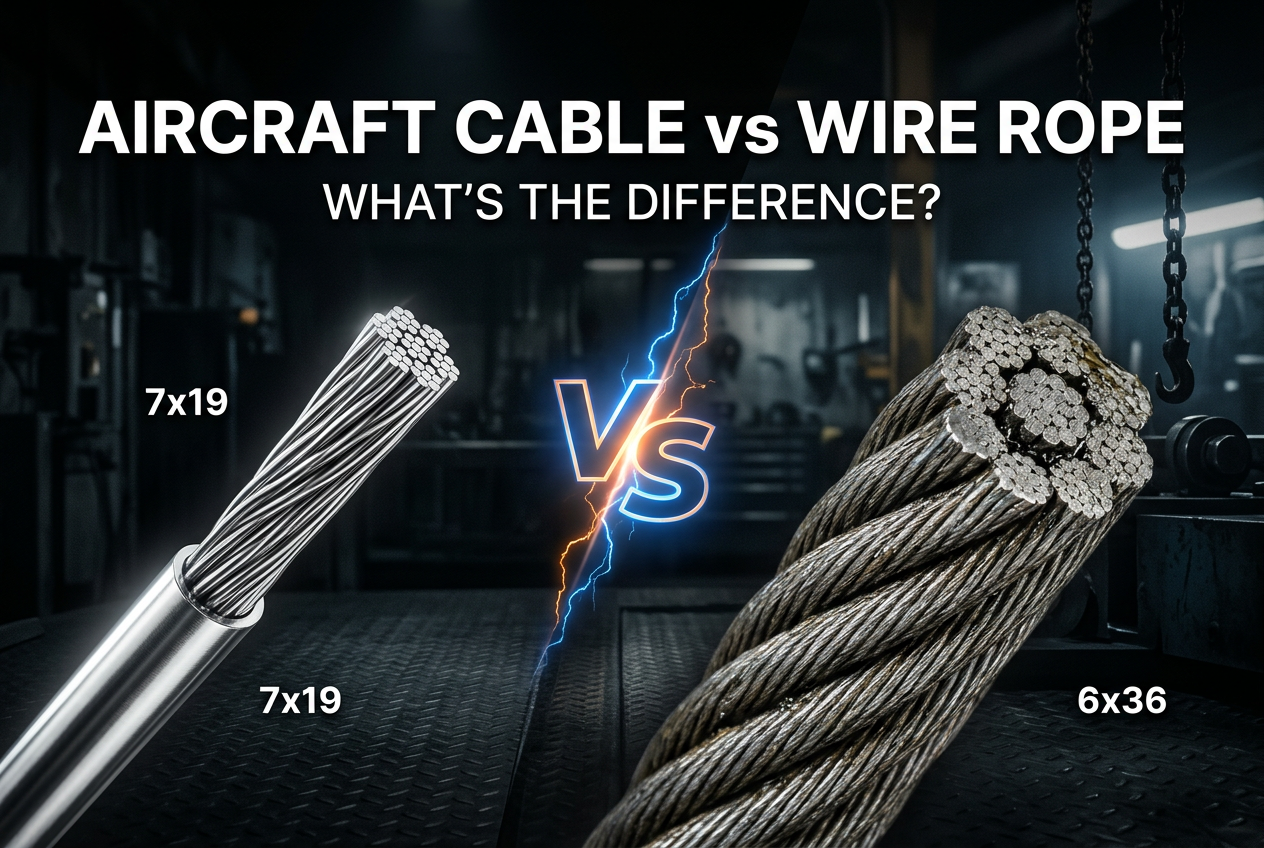
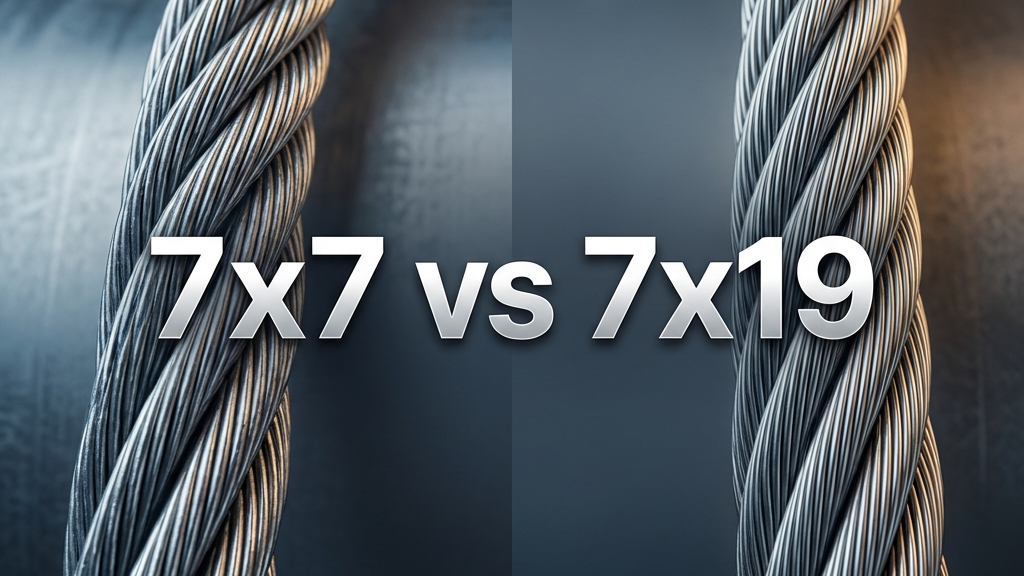
7x7 wire rope has 49 wires in 7 strands — it's stiffer, more abrasion-resistant, and best for architectural cables, guardrails, and fixed applications. 7x19 has 133 wires in 7 strands — it's more flexible, easier to handle, and ideal for rigging, marine use, and running over pulleys. Choose 7x7 for static loads, 7x19 for dynamic applications.
What Do the Numbers Mean?
Wire rope construction is described by two numbers separated by an "x" — for example, 7x7 or 7x19. The first number indicates the number of strands in the rope, while the second number indicates the number of individual wires within each strand. Understanding this notation is the key to selecting the right rope for your application.
A 7x7 wire rope consists of 7 strands, each made up of 7 individual wires, for a total of 49 wires. The construction features one center (core) strand surrounded by six outer strands. Within each strand, one center wire is surrounded by six outer wires. This relatively simple architecture produces a rope with moderate flexibility and excellent abrasion resistance.
A 7x19 wire rope also has 7 strands, but each strand contains 19 individual wires, yielding a total of 133 wires. Each strand is built in two layers: one center wire, six inner wires around it, and twelve outer wires around those. The dramatically higher wire count — nearly three times that of 7x7 — fundamentally changes the rope's mechanical behavior.
The more wires a rope contains at a given diameter, the thinner each individual wire must be. Thinner wires bend more easily, which makes the overall rope more flexible. Conversely, fewer, thicker wires create a stiffer rope that resists surface wear more effectively. This trade-off between flexibility and abrasion resistance is the central consideration when choosing between 7x7 and 7x19 constructions.
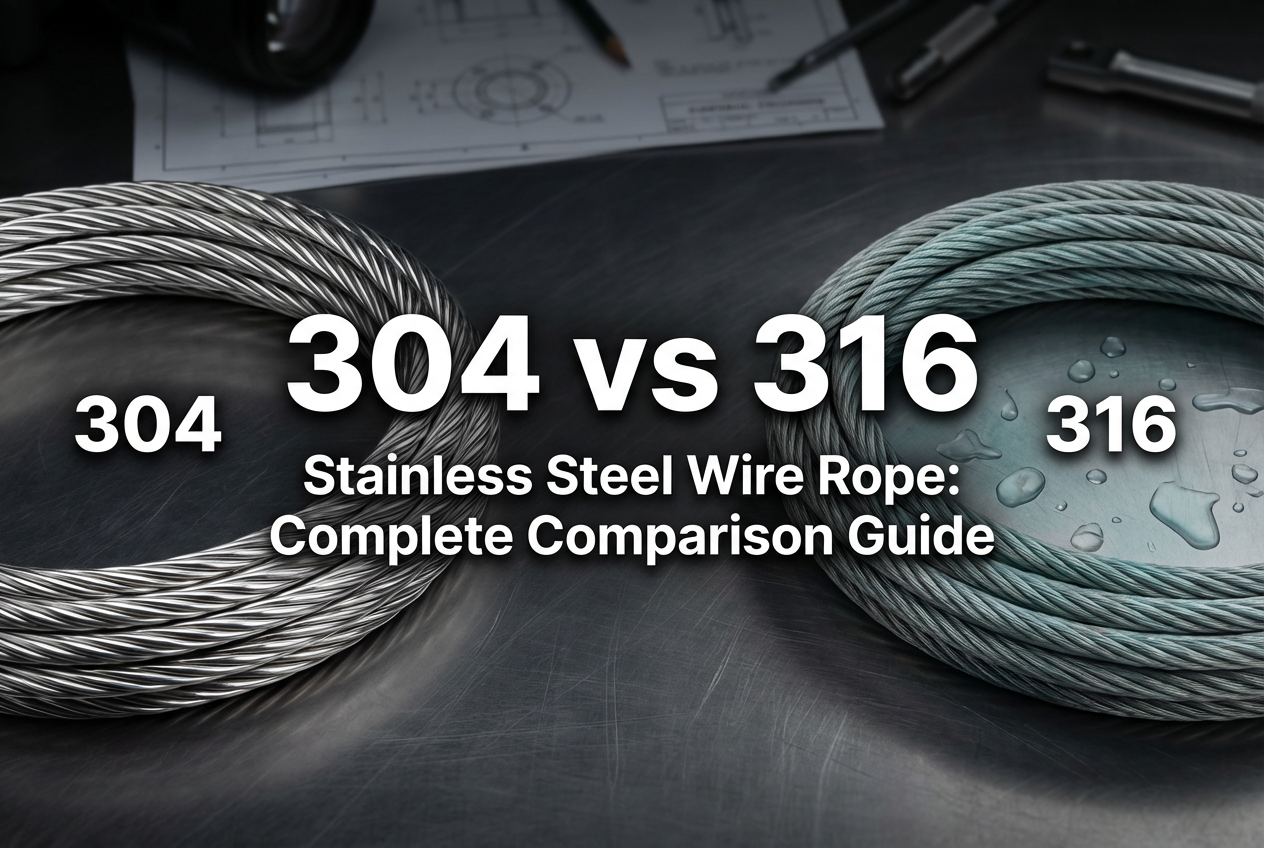
Both constructions are available in all common stainless steel grades — 304, 316, and 316L — and in diameters ranging from 0.5 mm to 20 mm or more. For a complete breakdown of available grades and their properties, see our 304 vs 316 comparison guide.
Flexibility Comparison
Flexibility is perhaps the most significant practical difference between 7x7 and 7x19 wire rope, and it influences almost every aspect of installation and performance. Flexibility in wire rope is determined by two main factors: the number of wires and the lay length (the helical pitch at which strands and wires are wound). More wires at a given rope diameter means thinner wires, and thinner wires flex more readily.
7x19 wire rope is substantially more flexible than 7x7. With 133 wires versus 49, the individual wires in a 7x19 rope are roughly 40% thinner (for the same overall rope diameter). This means a 7x19 rope can be bent around smaller radii, routed through sheaves and pulleys, and handled more easily during installation.
Minimum Bend Radius
The minimum bend radius — the tightest curve a rope can make without suffering permanent deformation or accelerated fatigue — is a critical specification for any application involving direction changes. Industry guidelines recommend the following minimum bend radii (expressed as a multiple of the rope diameter, d):
| Construction | Static Bend (no cycling) | Dynamic Bend (over pulleys) |
|---|---|---|
| 7x7 | 25d | 35d or more |
| 7x19 | 15d | 20d or more |
For a 5 mm diameter rope, this translates to a minimum static bend radius of 125 mm for 7x7 versus just 75 mm for 7x19. In dynamic applications where the rope repeatedly cycles over sheaves, the difference is even more pronounced. Using a 7x7 rope on an undersized sheave will dramatically shorten its fatigue life and can lead to sudden failure.
The practical consequence is straightforward: if your system involves pulleys, turning blocks, drum winches, or any repeated bending action, 7x19 is almost always the correct choice. If the rope runs in a straight line or makes only gentle, static curves, 7x7 will perform well and offer other advantages.
Strength and Abrasion Resistance
A common misconception is that 7x7 wire rope is stronger than 7x19 because it feels stiffer. In reality, for any given diameter and grade, both constructions have nearly identical breaking strengths. The nominal tensile strength of the wire (typically 1570–1770 MPa for stainless steel) is the same regardless of construction. The small differences in published breaking loads are due to variations in the metallic fill factor — the percentage of the rope's cross-section occupied by steel — rather than any fundamental strength advantage.
Abrasion Resistance: Advantage 7x7
Where 7x7 does hold a genuine advantage is in abrasion resistance. Because each of its 49 wires is thicker than the corresponding wires in a 133-wire 7x19 rope, the outer wires of a 7x7 rope can withstand more surface wear before their cross-section is significantly reduced. In applications where the rope slides against rough surfaces, passes through unlined guides, or is exposed to abrasive particles (sand, grit, rust scale), 7x7 will outlast 7x19.
The outer wire diameter ratio is approximately 1.6:1 — the outer wires of a 7x7 rope are roughly 60% thicker than those of a 7x19 rope at the same nominal diameter. This means 7x7 can lose significantly more material to surface abrasion before structural integrity is compromised.
Fatigue Life: Advantage 7x19
Fatigue failure occurs when a wire breaks due to repeated bending cycles, even when the applied load is well below the rope's breaking strength. Each time a wire bends over a sheave or drum, it experiences alternating tension and compression across its cross-section. Thinner wires develop lower bending stresses for a given bend radius, which is why 7x19 wire rope has a significantly longer fatigue life than 7x7 when subjected to repeated bending.
In laboratory bend-over-sheave tests, 7x19 rope typically achieves 3 to 5 times more bending cycles than 7x7 rope of the same diameter before the first wire break occurs. For any application where the rope regularly cycles over pulleys or drums — winches, hoists, cable-operated doors, exercise equipment — this fatigue advantage is decisive.
For detailed breaking strength data across all constructions and diameters, consult our breaking strength chart.
Application Guide
The choice between 7x7 and 7x19 ultimately depends on whether your application is primarily static (the rope stays in a fixed position under load) or dynamic (the rope moves, bends, or cycles during operation). The following table summarizes the most common applications for each construction:
| Application | Recommended Construction | Reason |
|---|---|---|
| Balustrade / railing infill cables | 7x7 | Static application; abrasion resistance; clean appearance |
| Architectural tension cables | 7x7 | Straight runs under constant tension; stiffness is desirable |
| Control cables (push-pull) | 7x7 | Moderate flexibility sufficient; good wear resistance in conduit |
| Guy wires and stays | 7x7 | Static tensile load; no bending cycles |
| Trellis and garden wire | 7x7 | Fixed installation; abrasion from vegetation contact |
| Pulley / sheave systems | 7x19 | Repeated bending requires high flexibility and fatigue life |
| Winch and drum applications | 7x19 | Rope wraps on drum; small bend radius; cyclic loading |
| Crane and hoist rigging | 7x19 | Dynamic lifting; safety-critical fatigue performance |
| Exercise / gym equipment cables | 7x19 | Thousands of bending cycles per day over small pulleys |
| Marine running rigging | 7x19 | Routed through blocks and fairleads; needs flexibility |
| Zip lines and adventure courses | 7x19 | Trolley wheels create dynamic bending at load point |
| Cable-operated doors and gates | 7x19 | Continuous cycling over drums and pulleys |
For a comprehensive guide on selecting the right wire rope across all parameters — construction, grade, diameter, and coating — read our complete selection guide. If your application involves saltwater or coastal exposure, also see our guide to marine wire rope applications for construction and grade recommendations specific to sailing rigging, lifelines, and running rigging.
What About 1x19?
While 7x7 and 7x19 are the most commonly compared constructions, it is worth briefly mentioning 1x19 — a construction that sits at the opposite end of the flexibility spectrum. A 1x19 rope is technically a single strand made of 19 wires (one center wire, six inner wires, and twelve outer wires). With no strand-over-strand helical structure, it is the stiffest and most stretch-resistant wire rope construction available.
1x19 is the preferred choice for standing rigging on sailboats — the shrouds and stays that hold the mast upright. In this role, minimal stretch is critical because any elongation under load would allow the mast to move, compromising the vessel's performance and safety. The rope remains under near-constant tension and never passes over pulleys, so flexibility is irrelevant.
1x19 is also used for long-span architectural cables, antenna guy wires, and any other application where absolute minimum stretch and maximum stiffness are required. However, it should never be used over pulleys or sheaves — bending a 1x19 rope to a tight radius will cause immediate and permanent deformation. Its minimum bend radius is typically 35–40 times the rope diameter, making it unsuitable for any application involving direction changes.
Browse all three constructions — 1x19, 7x7, and 7x19 — on our products page, or check the specifications page for detailed dimensional and strength data.
How to Decide: A Simple Flowchart
If you are still unsure which construction to specify, work through the following decision logic. It covers the vast majority of real-world scenarios and will lead you to the correct choice in under a minute.
Step 1: Does the Rope Pass Over Pulleys, Sheaves, or Drums?
If yes — the rope bends repeatedly during normal operation — choose 7x19. Its superior flexibility and fatigue life are essential for dynamic bending applications. Using 7x7 or 1x19 over undersized sheaves will result in premature wire breaks and potential failure. Proceed to confirm your diameter and grade using our selection guide.
Step 2: Is the Rope Installed in a Straight Line Under Constant Tension?
If the rope does not pass over pulleys and is tensioned in a straight or gently curved line — such as a balustrade infill, stay wire, or architectural cable — consider whether minimum stretch is your top priority:
- If minimal stretch and maximum stiffness are critical (e.g., standing rigging, long-span stays), choose 1x19.
- If moderate flexibility is acceptable and you want good abrasion resistance for a static or semi-static application, choose 7x7.
Step 3: Is Abrasion Resistance a Primary Concern?
If the rope will be dragged across rough surfaces, run through unlined guides, or exposed to sand, grit, or other abrasive materials, 7x7 is the better choice. Its thicker outer wires can tolerate more surface wear before the rope's breaking strength is meaningfully reduced.
Step 4: When in Doubt, Choose 7x19
If none of the above criteria clearly points to 7x7 or 1x19, 7x19 is the safest default. It is the most versatile construction — flexible enough for pulleys, strong enough for static loads, and widely available in all grades and diameters. It may sacrifice a degree of abrasion resistance compared to 7x7, but it will perform adequately in the widest range of applications.
Summary
The choice between 7x7 and 7x19 stainless steel wire rope comes down to a single fundamental question: does the rope need to bend? If it does — over pulleys, around drums, or through any kind of direction change — 7x19 is the clear winner, offering dramatically better flexibility and fatigue life. If the rope runs straight under static tension and abrasion resistance matters, 7x7 is the more durable option.
| Property | 7x7 (49 wires) | 7x19 (133 wires) |
|---|---|---|
| Flexibility | Moderate | High |
| Minimum Bend Radius (static) | 25d | 15d |
| Abrasion Resistance | Excellent | Good |
| Fatigue Life (bending cycles) | Moderate | Excellent (3–5x longer) |
| Breaking Strength | Same (for equal diameter & grade) | Same (for equal diameter & grade) |
| Best For | Static loads, railings, guy wires | Pulleys, winches, hoists, dynamic use |
Need help specifying the right construction, diameter, and grade for your project? Our engineering team is ready to assist. Contact us for a free consultation, technical recommendation, or sample.