Quick Answer
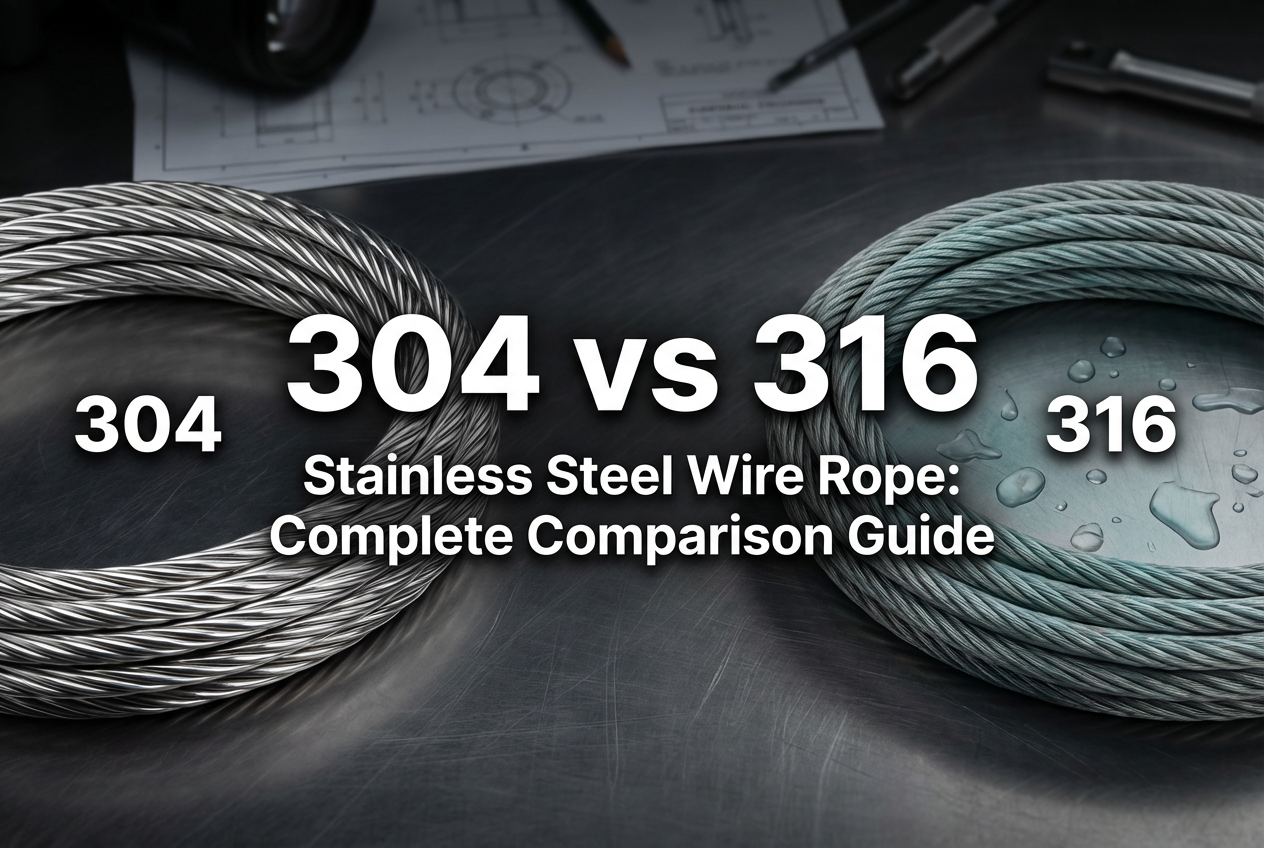
The key difference: 316 stainless steel contains 2–3% molybdenum, giving it superior saltwater and chemical corrosion resistance. Choose 316 for marine, coastal, and chemical environments. Choose 304 for indoor, freshwater, and general-purpose applications — it costs 20–30% less with adequate corrosion resistance for most non-marine uses.
Understanding Stainless Steel Grades
When sourcing stainless steel wire rope, the two grades you will encounter most often are 304 (SUS304 / 1.4301) and 316 (SUS316 / 1.4401). Both belong to the austenitic family of stainless steels, meaning they share a face-centered cubic crystal structure that gives them excellent formability, weldability, and toughness — even at cryogenic temperatures.
The fundamental difference lies in their chemical composition. Grade 304 contains approximately 18% chromium and 8% nickel, which is why it is sometimes called "18/8" stainless steel. Grade 316 keeps a similar chromium-nickel base but adds 2–3% molybdenum. This single alloying element is what separates an adequate wire rope from one that can survive the harshest chemical and marine environments on earth.
Both grades are non-magnetic in the annealed condition, although cold working (such as the wire-drawing process used to manufacture wire rope) can induce a small degree of magnetism. For most practical purposes, both 304 and 316 wire ropes are considered non-magnetic — an important consideration in instrumentation, MRI facilities, and compass-sensitive marine applications.
Understanding which grade to specify can mean the difference between a wire rope that lasts decades and one that fails prematurely due to corrosion. In this guide, we break down every factor you need to consider — from corrosion resistance and mechanical properties to cost and real-world application scenarios. You can also review our full technical specifications page for detailed tensile strength data across all constructions. If you haven't yet settled on a construction or diameter, start with our buyer's guide for a complete walkthrough of the selection process.
Corrosion Resistance: The Key Difference
Corrosion resistance is the single most important reason engineers choose 316 over 304. Both grades form a passive chromium-oxide layer on their surface that protects the underlying metal from atmospheric oxidation. However, this passive layer is vulnerable to attack by chloride ions — the ions present in seawater, de-icing salts, coastal air, and many industrial chemicals.
Chloride-Induced Pitting and Crevice Corrosion
Chloride ions can penetrate the chromium-oxide film at weak points, initiating localized pitting. Once a pit forms, the chemistry inside it becomes increasingly acidic, accelerating further attack in a self-sustaining cycle. Crevice corrosion follows the same mechanism but occurs in tight gaps — such as between individual wires in a rope strand — where stagnant solution concentrates chlorides.
The molybdenum in 316 dramatically raises the Critical Pitting Temperature (CPT) and the Pitting Resistance Equivalent Number (PREN). A higher PREN means the alloy can resist chloride attack at higher concentrations and temperatures. Typical PREN values are:
- 304: PREN ≈ 18–20
- 316: PREN ≈ 23–28
In practical terms, 304 performs well in freshwater, mild atmospheric conditions, and most food-processing environments. But once chloride levels rise — in swimming pools, marine atmospheres, brackish water, or chemical plants handling chlorinated solvents — 316 becomes essential.
Stress Corrosion Cracking (SCC)
Austenitic stainless steels are susceptible to stress corrosion cracking when exposed simultaneously to tensile stress, elevated temperature, and chloride-containing solutions. Wire rope is always under tension, making SCC a real concern. While neither grade is immune, 316's higher molybdenum content provides measurably better resistance. For critical applications in warm chloride environments (above roughly 60 °C), even 316 may require upgrading to duplex or super-austenitic grades — but between 304 and 316, the latter is clearly superior.
General Atmospheric Corrosion
In clean rural or urban atmospheres without significant salt spray, 304 wire rope will maintain a bright, clean surface for years. In coastal zones (within 1–2 km of the sea), however, 304 can develop surface rust staining known as "tea staining" within months. Grade 316 resists this far more effectively, maintaining its appearance and structural integrity in marine atmospheres.
Mechanical Properties Comparison
While corrosion resistance is the primary differentiator, mechanical properties also matter when selecting wire rope. The table below compares the key mechanical properties of 304 and 316 stainless steel wire (as drawn for rope production):
| Property | 304 (SUS304) | 316 (SUS316) |
|---|---|---|
| Nominal Tensile Strength (wire) | 1570–1770 MPa | 1570–1770 MPa |
| Yield Strength (0.2% proof) | ≥ 205 MPa (annealed) | ≥ 210 MPa (annealed) |
| Elongation at Break | ≥ 40% (annealed) | ≥ 40% (annealed) |
| Hardness (Brinell) | ≤ 187 HB (annealed) | ≤ 187 HB (annealed) |
| Density | 7.93 g/cm³ | 7.98 g/cm³ |
| Maximum Service Temperature | 870 °C (intermittent) | 870 °C (intermittent) |
| Magnetic Permeability | 1.02 (annealed) | 1.008 (annealed) |
As the data shows, the mechanical properties of 304 and 316 wire are remarkably similar. Both achieve the same nominal tensile strength range when cold-drawn to rope-grade wire. The breaking loads specified in standards such as GB/T 9944-2015 and DIN 3055 are identical for a given construction and diameter, regardless of grade. This means you can swap 304 for 316 (or vice versa) without changing the rope's load-carrying capacity.
The slight differences in yield strength and density are negligible for wire rope applications. The marginally lower magnetic permeability of 316 can be relevant for specialized instrumentation, but both grades are considered non-magnetic for most engineering purposes. For a complete breakdown of breaking loads by construction and diameter, visit our specifications page or see our complete breaking strength chart.
Cost Comparison
Cost is often the deciding factor when the corrosion environment does not strictly demand 316. The price premium of 316 over 304 wire rope typically ranges from 20% to 30%, though this fluctuates with nickel and molybdenum commodity prices.
Raw Material Cost Drivers
Molybdenum is significantly more expensive than the base elements in stainless steel. When molybdenum prices spike on global commodity markets, the 316 premium can exceed 35%. Conversely, when molybdenum is cheap, the gap narrows to around 15–20%. Nickel prices affect both grades roughly equally, so they move in tandem.
Total Cost of Ownership
The upfront cost comparison tells only half the story. In corrosive environments, 304 wire rope may need replacement every 3–5 years, while 316 can last 10–15 years or more. When you factor in:
- Material cost of replacement rope
- Labour and equipment downtime for re-rigging
- Safety risk of corrosion-induced failure
- Inspection and maintenance frequency
…the total cost of ownership for 316 is often lower than 304 in marine and chemical environments. The initial premium pays for itself many times over through extended service life and reduced maintenance.
When 304 Is the Smarter Buy
If your application is indoors, in a freshwater environment, or in a dry climate well away from the coast, 304 offers excellent performance at a lower price. There is no benefit to "over-specifying" 316 in environments where chloride exposure is minimal. Common examples include:
- Indoor architectural balustrade cables
- Freshwater aquaculture cages
- Gymnasium and fitness equipment cables
- Interior suspension and display systems
- Agricultural equipment in arid climates
Which Grade Should You Choose?
The decision comes down to your operating environment. Use the following guidelines:
Choose 304 When:
- The wire rope will be used indoors or in a controlled environment
- Exposure is limited to freshwater (lakes, rivers, municipal water)
- The atmosphere is rural or urban without significant industrial pollution or salt spray
- The application is decorative or light-duty (railings, display cables, signage)
- Budget constraints are tight and the environment is benign
Choose 316 When:
- The wire rope will be exposed to seawater, brackish water, or coastal air
- The application involves swimming pools or other chlorinated water
- The environment includes chemical exposure (acids, alkalis, chlorinated solvents)
- The rope is used in food and pharmaceutical processing (where sanitary standards require 316)
- The operating temperature exceeds 60 °C in a chloride-containing environment
- The application is safety-critical and long service life without inspection access is required
- You need the absolute best resistance to pitting and crevice corrosion
For a visual reference of all available wire rope constructions and their applications, browse our product catalog. For a deeper look at 316's performance in saltwater and coastal conditions, see our guide to stainless steel wire rope for marine use. If budget is a major constraint and your environment is less demanding, also compare both grades against zinc-coated rope in our stainless steel vs galvanized wire rope guide.
316L: When Do You Need the Low-Carbon Version?
You may also encounter 316L (SUS316L / 1.4404) in wire rope specifications. The "L" stands for "low carbon" — the maximum carbon content is reduced from 0.08% (standard 316) to 0.03%.
The purpose of this carbon reduction is to prevent sensitization — a phenomenon where chromium carbides precipitate at grain boundaries during welding or prolonged exposure to temperatures between 450–850 °C. Sensitization depletes chromium from the region adjacent to grain boundaries, creating a narrow zone that is vulnerable to intergranular corrosion.
When 316L Matters
- Welded assemblies: If the wire rope end fittings will be welded (rather than swaged or mechanically crimped), 316L prevents sensitization in the heat-affected zone.
- High-temperature service: If the wire rope operates continuously above 450 °C, 316L offers better long-term intergranular corrosion resistance.
- Regulatory requirements: Some marine classification societies and pharmaceutical standards mandate 316L specifically.
When Standard 316 Is Sufficient
For the vast majority of wire rope applications, standard 316 is perfectly adequate. Wire rope is not typically welded in the field, and service temperatures rarely exceed 100 °C. The mechanical properties of 316 and 316L are virtually identical — the low-carbon variant does not sacrifice strength. However, if your specification or industry standard calls for 316L, there is no cost penalty to upgrading, as most reputable wire rope manufacturers (including Qianjun) stock 316L as their default 316-grade product.
Summary: Making the Right Choice
Choosing between 304 and 316 stainless steel wire rope is not complicated once you understand the environmental demands of your application. Here is a quick-reference summary:
| Factor | 304 | 316 |
|---|---|---|
| Chloride / Seawater Resistance | Moderate | Excellent |
| General Atmospheric Corrosion | Very Good | Excellent |
| Mechanical Strength | 1570–1770 MPa | 1570–1770 MPa |
| Cost | Base price | +20–30% |
| Best For | Indoor, freshwater, dry climate | Marine, chemical, coastal, pools |
| Typical Service Life (corrosive env.) | 3–5 years | 10–15+ years |
If you are still unsure which grade is right for your project, our engineering team is happy to review your requirements and recommend the optimal specification. Contact us for a free consultation, sample, or quotation.