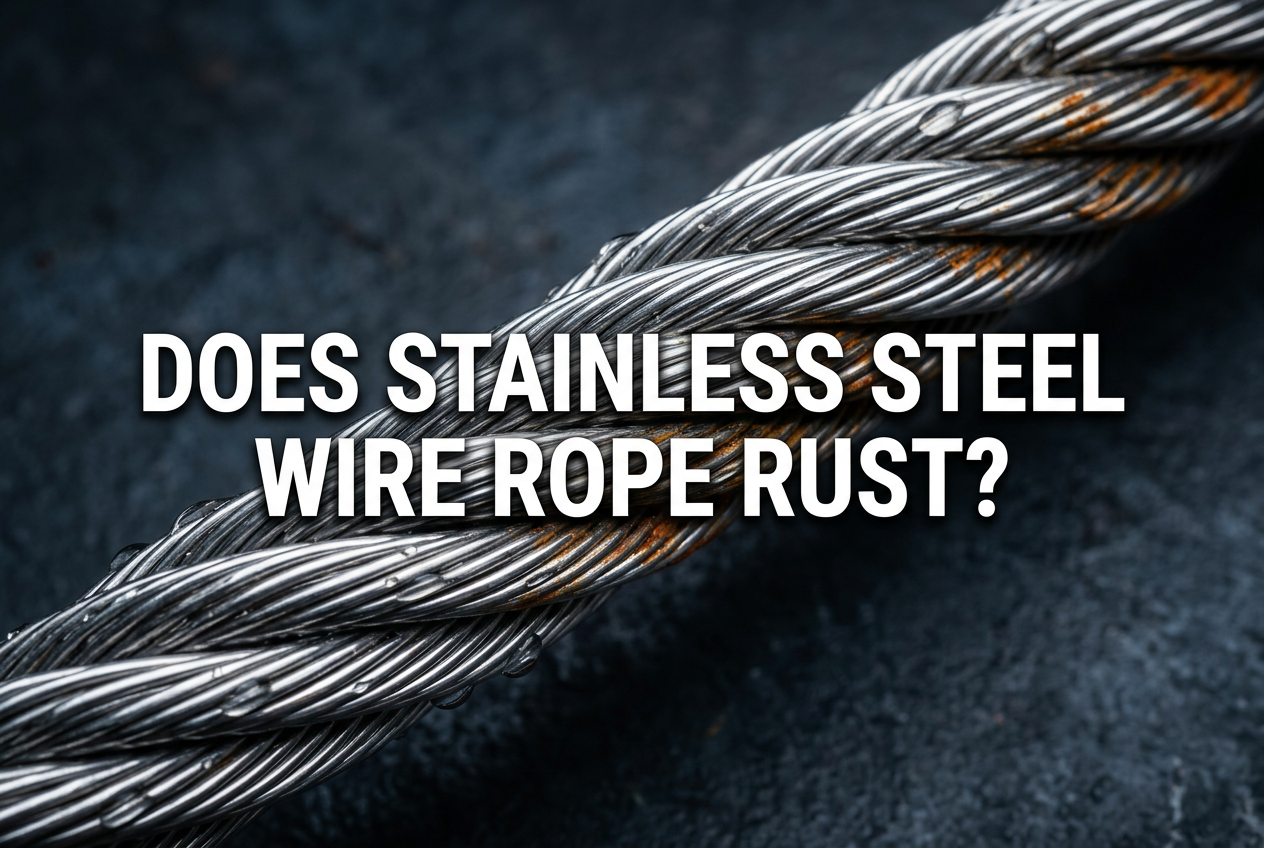
Quick Answer
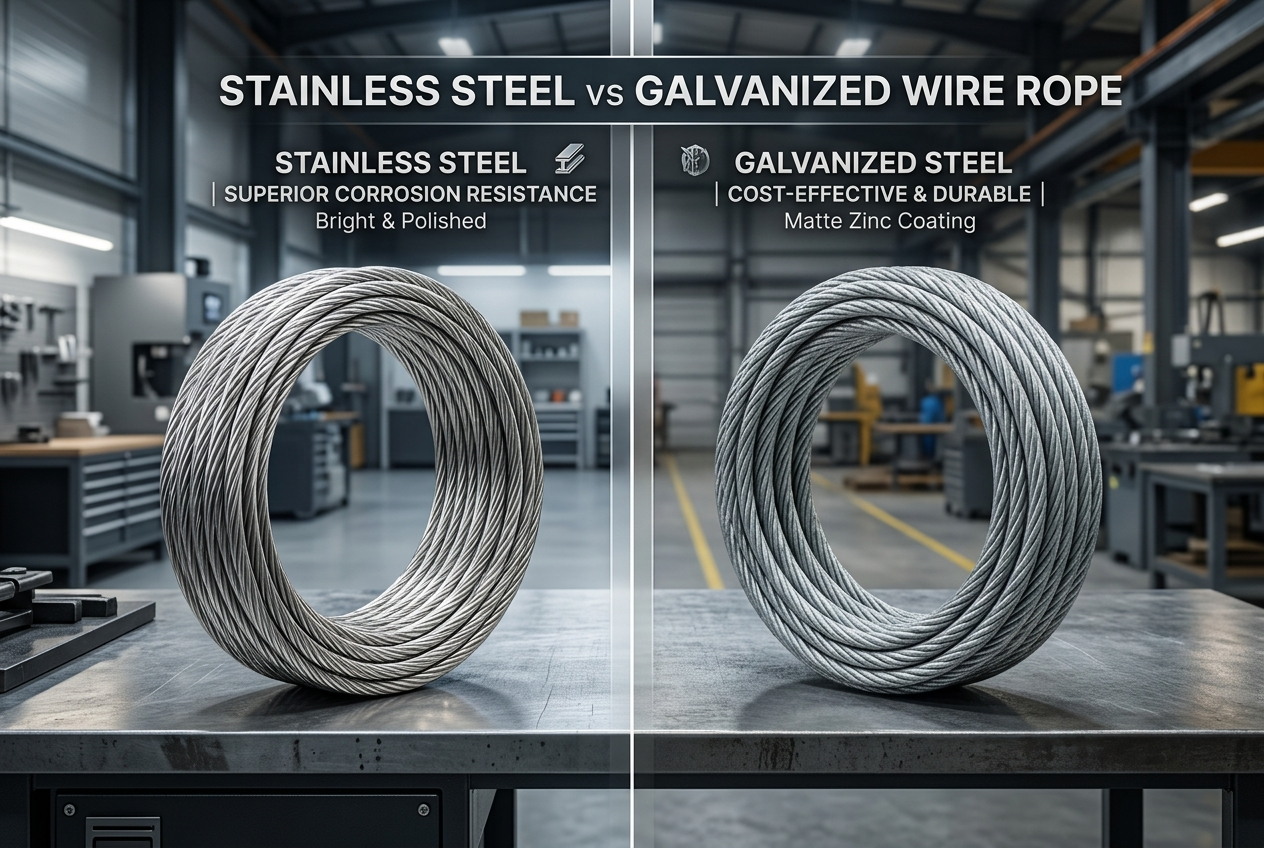
Stainless steel wire rope offers superior corrosion resistance and longer lifespan, especially in marine and outdoor environments. Galvanized wire rope costs 40–60% less and provides adequate protection for indoor and dry applications. Choose stainless steel (304/316) when corrosion resistance matters most; choose galvanized when budget is the priority and exposure to moisture is minimal.
What Is Galvanized Wire Rope?
Galvanized wire rope is carbon-steel wire rope that has been coated with a layer of zinc to slow corrosion. There are two main galvanizing processes:
- Hot-dip galvanizing: Individual wires are drawn through a bath of molten zinc at around 450 °C. The zinc metallurgically bonds to the steel, forming a thick, durable coating (typically 80–120 µm). Hot-dip galvanized rope is the most common type used in construction, agriculture, and general industry.
- Electro-galvanizing: Zinc is deposited electrochemically onto the wire in a much thinner layer (10–30 µm). This produces a smoother, brighter surface but offers significantly less corrosion protection than hot-dip galvanizing.
In both cases, zinc protects the underlying steel through two mechanisms: a physical barrier that keeps moisture away from the steel surface, and sacrificial (cathodic) protection— because zinc is less noble than steel, it preferentially oxidizes when the coating is scratched or damaged, protecting exposed steel until the zinc is consumed.
Common standards for galvanized wire rope include ASTM A475 (zinc-coated steel wire rope), EN 10244 (zinc coatings on steel wire), andGB/T 1102 (Chinese national standard for round-strand wire ropes). Galvanized rope is typically manufactured from high-carbon steel (IPS or EIP grade), giving it high tensile strength comparable to stainless alternatives.
What Is Stainless Steel Wire Rope?
Stainless steel wire rope is made entirely from corrosion-resistant alloy steel wire. The two grades you will encounter most often are 304 and 316:
- Grade 304 (SUS304 / 1.4301): Contains approximately 18% chromium and 8% nickel. Offers very good corrosion resistance in atmospheric and freshwater environments. The most widely used grade for indoor architectural, fitness, and general industrial applications.
- Grade 316 (SUS316 / 1.4401): Adds 2–3% molybdenum to the 304 base, raising its resistance to chloride-induced pitting and crevice corrosion. The preferred choice for marine, coastal, chemical, and food-processing environments.
Both grades derive their corrosion resistance from a self-healing chromium-oxide passive film that forms spontaneously on the surface when exposed to oxygen. Unlike zinc, this layer does not gradually deplete — it regenerates whenever the surface is clean and oxygen is present, giving stainless steel essentially unlimited atmospheric corrosion resistance under normal conditions.
For a detailed comparison of 304 and 316 grades, see our article 304 vs 316 Stainless Steel Wire Rope: Key Differences Explained.
Side-by-Side Comparison
The table below compares 316 stainless steel, 304 stainless steel, and hot-dip galvanized wire rope across the most important selection criteria:
| Feature | Stainless Steel 316 | Stainless Steel 304 | Hot-Dip Galvanized |
|---|---|---|---|
| Corrosion Resistance | Excellent | Very Good | Moderate |
| Saltwater Use | Yes | Limited | No |
| Tensile Strength | High (1570–1770 MPa) | High (1570–1770 MPa) | High (1570–1960 MPa) |
| Lifespan (outdoor) | 20–30 years | 15–20 years | 5–10 years |
| Cost (relative) | $$$ | $$ | $ |
| Temperature Range | −60 °C to 800 °C | −60 °C to 800 °C | −40 °C to 400 °C |
| Magnetic Properties | Non-magnetic | Slightly magnetic | Magnetic |
| Appearance | Bright, maintains finish | Bright, maintains finish | Dull gray, darkens over time |
For exact minimum breaking force values by diameter and construction, see our breaking strength chart.
When to Choose Stainless Steel Wire Rope
Stainless steel is the right choice whenever long-term performance, appearance, or safety in harsh environments matters. Specific applications include:
- Marine and coastal environments: Seawater rapidly destroys zinc coatings. 316-grade stainless steel resists chloride-induced pitting and crevice corrosion, making it the standard for boat rigging, lifelines, dock hardware, and offshore structures. For more detail, see our guide on stainless steel wire rope for marine applications.
- Food processing and pharmaceutical: Sanitary regulations typically require 316L stainless steel in direct-contact applications. Zinc coatings are not food-safe and can contaminate product streams.
- Architectural and decorative: Stainless steel maintains a bright, attractive finish indefinitely with minimal maintenance. Common uses include balustrade cables, facade tensile systems, and interior suspension wires.
- Chemical exposure environments: Where acids, solvents, or industrial chemicals are present, the zinc on galvanized rope dissolves rapidly. Stainless steel — and especially 316 — provides reliable resistance to most dilute acids and chlorinated compounds.
- Long-lifecycle infrastructure: For bridge cables, suspended roofs, and permanent outdoor structures, the extended service life of stainless steel reduces the total cost of ownership over decades.
When to Choose Galvanized Wire Rope
Galvanized wire rope remains the dominant choice in many industries because it offers excellent value where the corrosion environment is moderate:
- Indoor crane and lifting operations: In covered workshops and warehouses away from moisture, galvanized rope performs reliably at a fraction of the cost of stainless steel. The zinc coating handles condensation and light oil exposure with ease.
- Agricultural fencing (non-coastal): High-tensile galvanized wire is the industry standard for livestock fencing and vineyard trellising in regions without significant salt exposure.
- Temporary rigging and construction: Scaffold ties, formwork supports, and temporary guy wires have short service lives where a less expensive material is entirely appropriate.
- Budget-sensitive projects with dry conditions: When moisture exposure is minimal and the budget is tight, hot-dip galvanized rope offers excellent mechanical properties at the lowest cost per meter.
Cost Comparison and Total Cost of Ownership
The upfront price difference between galvanized and stainless steel wire rope is significant. Hot-dip galvanized rope typically costs 40–60% less than an equivalent 304-grade stainless rope, and up to 70% less than 316. For large-volume purchases, this difference can amount to tens of thousands of dollars on a single project.
However, upfront cost tells only half the story. In outdoor and moderately corrosive environments, consider the full replacement cycle:
- A galvanized rope installed at a coastal marina may need replacement every 3–5 years as the zinc coating depletes and the underlying steel corrodes.
- A 316 stainless steel rope in the same environment can reliably serve for 20–30 years with only periodic cleaning.
Over a 10-year period, a marina installing galvanized rope might replace it twice — incurring material costs plus labor, downtime, and potential safety risk during each replacement. The 316 stainless steel rope requires no replacement at all during the same window. When these factors are accounted for, stainless steel typically delivers a lower total cost of ownership in any application with significant moisture or chemical exposure.
For dry indoor applications, the galvanized option usually wins on total cost as well — because its 20+ year service life in a protected environment eliminates the need for early replacement.
Common Mistakes to Avoid
Understanding the limitations of each material helps you avoid costly errors:
- Using galvanized rope in saltwater: This is the single most common and costly mistake. Seawater contains roughly 35,000 ppm of chloride — enough to accelerate zinc depletion dramatically. A galvanized rope that lasts 10 years inland may fail within 12–18 months in a saltwater environment.
- Mixing stainless and galvanized fittings: When stainless steel rope contacts galvanized fittings (or vice versa) in a wet environment, galvanic corrosion can accelerate zinc loss. The two metals have different electrochemical potentials, creating a galvanic cell when an electrolyte (salt water or condensation) is present. Always match fitting material to rope material, or use an insulating barrier.
- Choosing 304 where 316 is needed: Coastal, marine, and pool environments require 316. Engineers sometimes specify 304 to save cost, only to find it developing surface rust or pitting within months of installation in high-chloride conditions.
- Neglecting the zinc condition on galvanized rope: A visual inspection that confirms bright zinc means remaining life. Gray or rust-stained sections signal that the zinc is nearly depleted. Inspect galvanized rope regularly in outdoor or damp environments.
Summary: Making the Right Choice
The choice between stainless steel and galvanized wire rope is ultimately driven by your operating environment and service life requirements:
| Application | Recommended Type | Grade |
|---|---|---|
| Marine / coastal / saltwater | Stainless Steel | 316 |
| Swimming pools / chlorinated water | Stainless Steel | 316 |
| Outdoor architectural cables | Stainless Steel | 304 or 316 |
| Food processing / pharma | Stainless Steel | 316L |
| Indoor hoisting / cranes | Galvanized | Hot-dip |
| Agricultural fencing (dry climate) | Galvanized | Hot-dip |
| Temporary construction rigging | Galvanized | Hot-dip or electro |
If you are unsure which type is right for your project, our engineering team can review your environment and load requirements to recommend the optimal specification. Contact us for a free consultation, sample, or quotation. For a full walkthrough of selecting construction, grade, diameter, and coating, see our complete buyer's guide.