Why Marine Environments Demand Stainless Steel
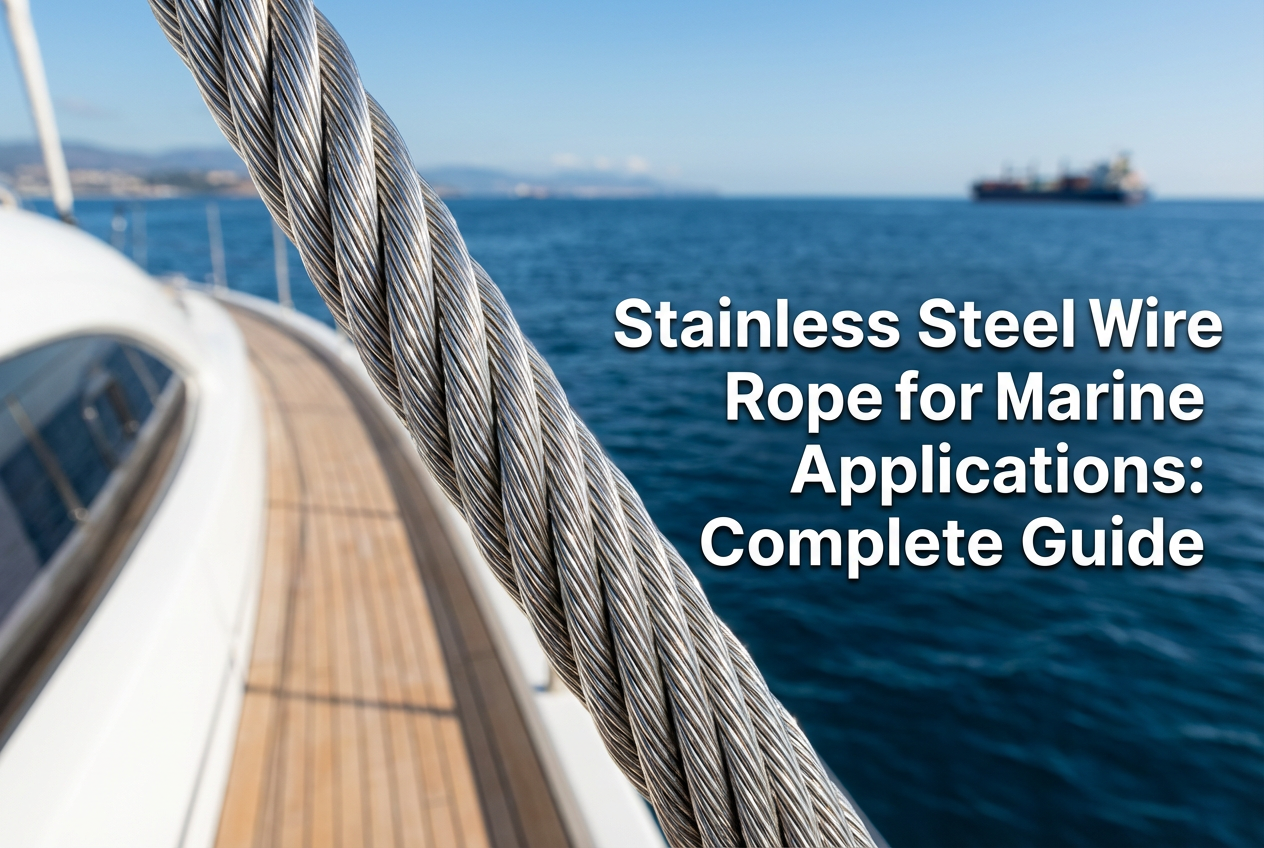
The ocean is one of the most aggressive environments any metal can face. Constant exposure to salt spray, chloride-laden moisture, and UV radiation creates conditions that will rapidly corrode carbon steel, galvanized wire, and even some lower-grade stainless steels. Unlike inland or industrial settings where corrosion develops over years, marine corrosion can visibly degrade unprotected metals within weeks.
Three factors make the marine environment uniquely hostile to wire rope. First, airborne chloride ions from sea spray penetrate the passive oxide layer that protects stainless steel. Once the passive layer is breached, pitting corrosion begins — small but deep cavities that concentrate stress and can initiate fatigue cracks. Second, the continuous cycle of wetting and drying as waves, spray, and rain alternate concentrates salt deposits on rope surfaces, accelerating the attack during dry periods. Third, galvanic corrosion becomes a serious risk when dissimilar metals are in contact in the presence of saltwater, which is an excellent electrolyte.
For these reasons, any wire rope used in a marine application — whether on a sailing yacht, a commercial fishing vessel, an offshore platform, or a coastal architectural structure — must be manufactured from a stainless steel grade specifically engineered for chloride resistance. In practice, this means 316-grade stainless steel is the minimum acceptable standard for any wire rope that will be exposed to seawater or salt air.
Carbon steel wire rope, even when galvanized, will develop surface rust within the first season of marine use. The zinc coating provides temporary sacrificial protection, but once depleted — typically within one to three years in a saltwater environment — the underlying steel corrodes rapidly. Galvanized wire rope is appropriate for freshwater or light industrial use, but it is fundamentally unsuitable for marine service where long-term reliability is required.
Choosing the Right Grade: 304 vs 316 for Marine Use
Both 304 and 316 stainless steels belong to the austenitic family and share many characteristics — excellent formability, good weldability, and a bright, corrosion-resistant surface. However, their performance in marine environments diverges dramatically due to a single compositional difference: molybdenum content.
Grade 316 contains 2–3% molybdenum, while 304 contains essentially none. Molybdenum significantly enhances resistance to pitting and crevice corrosion — the two forms of attack most prevalent in chloride-rich environments. In standardized salt spray testing (ASTM B117), 316 stainless steel consistently withstands exposure two to three times longer than 304 before the first pit appears.
In real-world marine conditions, this laboratory advantage translates to a dramatic difference in service life. 304 stainless steel wire rope used in direct saltwater exposure will typically show visible pitting within 6–18 months. The pits act as stress concentrators, reducing the rope's effective breaking strength and initiating fatigue cracks. Once pitting begins, the rate of corrosion accelerates because the chemistry inside each pit becomes increasingly acidic, further attacking the metal.
Grade 316 wire rope, under the same conditions, will maintain its passive layer and structural integrity for many years — often a decade or more with proper maintenance. The molybdenum creates a more robust passive film that resists chloride penetration far more effectively than the chromium-oxide layer alone.
For any marine application, 316 (or 316L) is the only appropriate grade. The cost premium of 316 over 304 is typically 15–25%, but the difference in service life is measured in multiples, not percentages. Replacing a corroded 304 rigging wire involves not just material cost but significant labor for re-rigging, potential downtime, and — in safety-critical applications like lifelines — unacceptable risk.
For a detailed comparison of the chemical composition, mechanical properties, and application mapping of both grades, see our 304 vs 316 complete comparison guide.
Common Marine Wire Rope Applications
Stainless steel wire rope serves a remarkably wide range of functions aboard vessels and in coastal infrastructure. Each application places different demands on the rope's construction, diameter, and flexibility. Below, we break down the four most common categories of marine wire rope use — for a deeper look at how these constructions differ in flexibility and fatigue life, see our 7x7 vs 7x19 construction guide.
Standing Rigging (1x19)
Standing rigging refers to the permanent, load-bearing wires that support a sailboat's mast. This includes the forestay (running from the masthead to the bow), the backstay (masthead to stern), and the shrouds (masthead to the sides of the hull, often via spreaders). Standing rigging is under constant tension and must resist elongation under load — any stretch allows the mast to move, degrading sailing performance and potentially causing structural failure.
1x19 construction is the universal standard for standing rigging. Its single-strand architecture with 19 wires produces the stiffest, lowest-stretch wire rope available. Because standing rigging does not pass over pulleys or make sharp bends, the low flexibility of 1x19 is not a disadvantage — in fact, it is precisely the desired characteristic.
Typical diameters for standing rigging range from 3 mm for small daysailers to 12 mm or larger for offshore cruisers and racing yachts. The wire is terminated with swaged or mechanical fittings (such as Sta-Lok or Norseman terminals) at each end. All standing rigging wire must be 316 grade — the consequences of corrosion-induced failure at sea are too severe to accept the lower chloride resistance of 304.
Lifelines and Guardrails (7x7)
Lifelines are the safety wires that run around the perimeter of a vessel's deck, supported by stanchions, to prevent crew from falling overboard. Regulatory bodies such as ISAF (World Sailing) and the US Coast Guard specify minimum wire diameters and construction requirements for lifelines on racing and cruising vessels.
7x7 construction is the preferred choice for lifelines. It offers a good balance between stiffness (to maintain tension between stanchions without excessive sag) and enough flexibility to be easily threaded through pelican hooks, turnbuckles, and stanchion eyes during installation. The thicker outer wires of 7x7 also provide better abrasion resistance where the wire contacts stanchion tops and hardware.
Standard lifeline diameters are 4 mm (5/32") or 5 mm (3/16"), with 5 mm being the most common on vessels over 9 meters. All lifeline wire should be 316 grade, and the wire should be inspected annually for broken strands, pitting, or discoloration at swage fittings — areas where crevice corrosion is most likely to develop.
Running Rigging (7x19)
Running rigging encompasses all the lines and wires that move during sailing operations — halyards (which hoist sails), sheets (which control sail angle), and various control lines. While modern running rigging is predominantly made from synthetic fiber (Dyneema, Spectra, or polyester), stainless steel 7x19 wire is still used for certain applications, particularly wire halyards on performance-oriented sailboats.
Wire halyards made from 7x19 construction offer near-zero stretch under load, which is critical for maintaining optimal sail shape in racing conditions. The 7x19 construction is essential because halyards pass over sheaves at the masthead — the rope must be flexible enough to bend around these pulleys without suffering fatigue damage.
Common wire halyard diameters range from 5 mm to 8 mm, depending on the vessel size and the loads involved. Many modern sailboats use a hybrid approach: a wire upper section for low stretch combined with a fiber tail for easy handling on the winch.
Anchor and Mooring Systems
While anchor rodes are typically composed of chain or a chain-and-nylon combination, stainless steel wire rope plays a supporting role in several mooring and anchoring applications. These include mooring pendants (short wire sections connecting a mooring buoy to the vessel's deck hardware), bridle wires (distributing mooring loads across two bow cleats), and snubber attachments that incorporate wire sections for chafe resistance.
In commercial marine applications, 316 wire rope is used for trawl cables, fish trap leaders, lobster pot warp reinforcements, and other fishing-related uses where corrosion resistance is essential and the wire is continuously immersed in seawater.
Construction choice depends on the specific application: 7x7 for static mooring pendants, 7x19 for any application involving pulleys or fairleads. Diameters typically range from 4 mm to 10 mm for recreational vessels and up to 16 mm or larger for commercial applications.
Recommended Constructions and Sizes
The following table maps common marine applications to their recommended wire rope specifications. All entries assume 316 or 316L grade stainless steel.
| Application | Construction | Typical Diameter | Key Requirement |
|---|---|---|---|
| Forestay / Backstay | 1x19 | 5–10 mm | Minimum stretch, maximum stiffness |
| Shrouds (upper) | 1x19 | 5–12 mm | High static tensile load |
| Shrouds (lower) | 1x19 | 4–8 mm | Static load, shorter span |
| Lifelines | 7x7 | 4–5 mm | Moderate stiffness, abrasion resistance |
| Guardrail (bow pulpit) | 7x7 | 5–6 mm | Stiffness between stanchions |
| Wire halyards | 7x19 | 5–8 mm | Flexibility over masthead sheaves |
| Control cables | 7x19 | 3–5 mm | Flexibility through conduit/fairleads |
| Mooring pendants | 7x7 | 6–10 mm | Static load, chafe resistance |
| Trawl / fishing cables | 7x19 | 6–12 mm | Flexibility over winch drums |
| Davit / tender hoist | 7x19 | 5–8 mm | Dynamic bending over pulleys |
For detailed breaking strength data across these constructions and diameters, refer to our product catalog, the applications page, or our breaking strength reference chart.
Maintenance Tips for Marine Wire Rope
Even 316 stainless steel requires regular maintenance to achieve its full potential lifespan in a marine environment. Salt deposits, if left undisturbed, will eventually attack even the most corrosion-resistant grades. The following maintenance practices will maximize the service life of your marine wire rope and help you identify potential problems before they become safety hazards.
Freshwater Rinse After Every Sail
The single most effective maintenance practice is rinsing all wire rope and fittings with fresh water after each exposure to salt spray. This removes chloride deposits before they can concentrate and attack the passive layer. Pay particular attention to swage fittings, turnbuckle threads, and any area where the wire passes through a fitting — these are crevice corrosion hot spots where salt can accumulate out of sight. A thorough freshwater washdown after each sailing day takes only minutes but can add years to your rigging's service life.
Lubrication
While stainless steel wire rope does not rust in the traditional sense, lubrication serves two important functions in the marine environment. First, it reduces internal friction between wires and strands, which extends fatigue life — particularly important for 7x19 running rigging that passes over sheaves. Second, a light coating of marine-grade lubricant (such as Boeshield T-9 or a PTFE-based spray) creates a barrier against chloride penetration into the rope's interior.
Apply lubricant sparingly — a thin, even coating is more effective than a heavy application that will attract dirt and grit. Avoid petroleum-based greases that can degrade adjacent synthetic lines or deck finishes. Re-apply lubricant every 3–6 months, or more frequently if the vessel is used in tropical or high-salinity waters.
Regular Inspection
All marine wire rope should be visually inspected at least every six months, with a more thorough hands-on inspection at the start and end of each sailing season. During inspection, look for the following warning signs:
- Broken wires: Run a cloth along the rope — it will snag on any protruding wire ends. Even a single broken wire in standing rigging warrants immediate further investigation.
- Rust staining: Brown or orange discoloration indicates that either the wire itself is corroding (possibly due to contamination from carbon steel tools) or that a nearby carbon steel component is shedding rust onto the stainless surface.
- Pitting: Small dark spots or rough patches on the wire surface indicate chloride-induced pitting. Pitting near a swage fitting is particularly concerning, as it may indicate hidden crevice corrosion inside the fitting.
- Deformation or kinking: Any permanent bend, kink, or birdcage (strand separation) means the wire has been overloaded or improperly handled and should be replaced.
- Swage fitting cracks: Inspect the barrel of swaged terminals for hairline cracks, which indicate fatigue failure of the fitting itself.
For a complete field checklist covering all of these inspection points in detail, see our wire rope inspection checklist.
Standing rigging on a cruising sailboat should be replaced every 10–15 years regardless of visible condition, as internal fatigue damage may not be externally visible. Racing yachts and charter vessels that experience higher cyclic loads should consider replacement every 7–10 years.
Why Source From Qianjun?
Qianjun is a specialist stainless steel wire rope manufacturer based in Taizhou, Jiangsu — one of China's primary stainless steel production regions. We supply marine-grade wire rope to boatbuilders, rigging suppliers, and marine hardware distributors across Asia, Europe, and the Americas. Here is what sets us apart for marine customers:
- Factory-direct pricing: As a manufacturer, not a trading company, we eliminate intermediary markups. This is particularly significant for 316/316L wire rope, where the raw material cost of molybdenum-bearing steel makes grade selection the single largest cost driver.
- 316 and 316L always in stock: We maintain rolling inventory of 316 and 316L wire rope in all three common marine constructions — 1x19, 7x7, and 7x19 — in diameters from 1 mm to 16 mm. Standard lengths ship within 2–3 business days.
- Mill Test Certificates (MTC): Every coil ships with a full MTC tracing the stainless steel back to the smelter. The certificate includes chemical analysis confirming molybdenum content, tensile strength test results, and construction verification. This documentation is essential for marine surveyors, classification societies, and quality-conscious buyers.
- Custom cutting and packaging: We offer precision cut-to-length service for standing rigging applications, with sealed end caps to prevent fraying during transit. Minimum order quantities are flexible — we serve both large-volume distributors and small boatyards with equal attention.
- GB/T 9944, DIN 3055, and ASTM A492 compliance: Our wire rope is manufactured and tested to international standards, ensuring compatibility with marine hardware and fittings sourced globally.
Whether you are re-rigging a single sailboat or stocking a marine chandlery, we can supply the right 316 stainless steel wire rope for the job — at the right price, with the documentation to prove its quality. Contact our sales team for a quotation, free sample, or technical consultation.