Quick Answer
For cable railing systems, 1x19 construction in 316 stainless steel (1/8" or 3mm diameter) is the most popular choice. It offers excellent rigidity for horizontal runs, superior corrosion resistance, and meets most building codes including IBC and IRC.
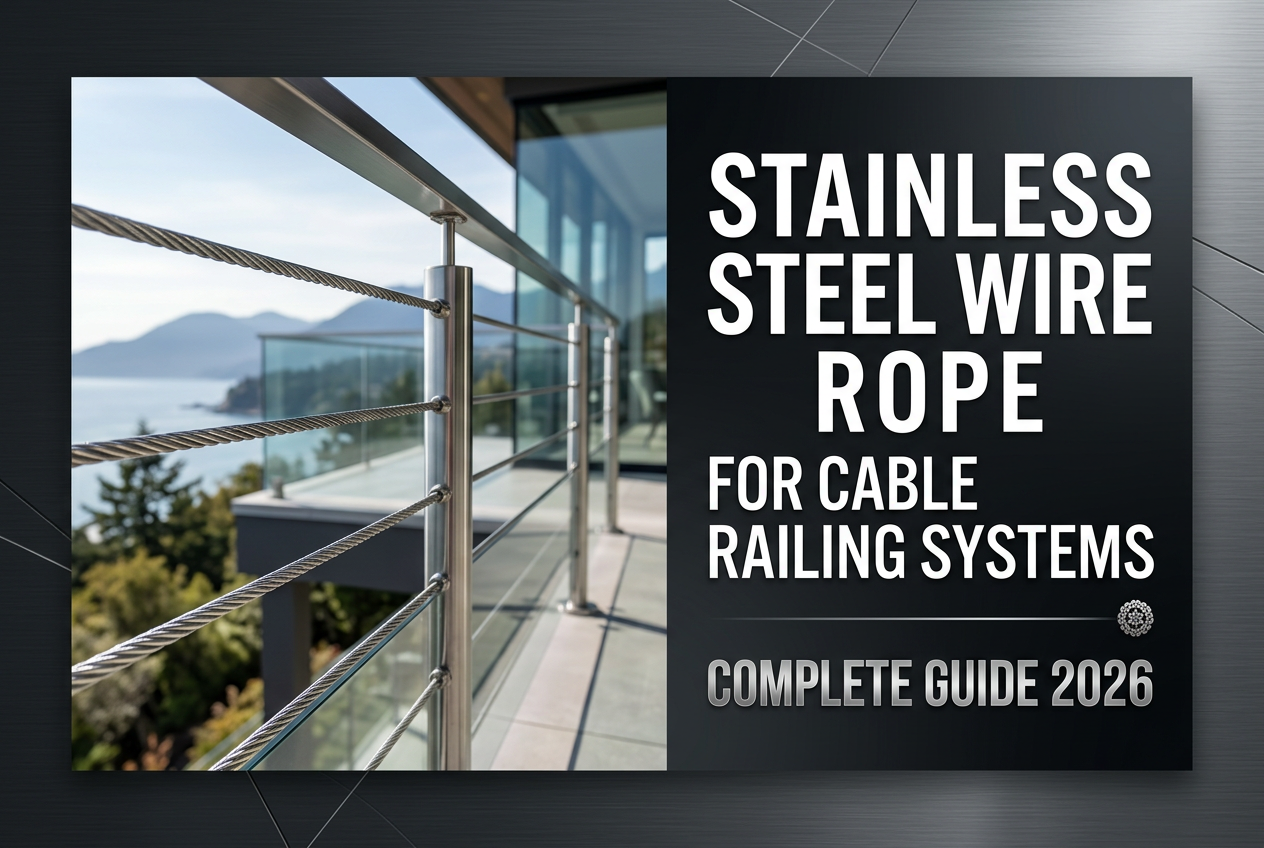
Cable railing has become one of the most requested railing styles for modern decks, staircases, and balconies — and for good reason. Thin stainless steel cables preserve the view that a solid or picket railing would block, they never rot or peel, and they give any project a clean, architectural look. But the system is only as good as the wire rope inside it. Choose the wrong construction and your cables will sag between posts; choose the wrong grade and rust spots will appear within a season.
This guide covers everything homeowners, contractors, and architects need to specify the right stainless steel wire rope for a cable railing project: construction type, material grade, diameter, building code requirements, hardware, installation, maintenance, and cost. It applies equally to residential decks in the US, coastal homes in Australia, and balcony balustrades in Europe — with both imperial and metric sizing throughout.
Why Stainless Steel for Cable Railing?
Cable railing infill lives outdoors, under constant tension, in direct contact with fittings and posts, for decades. Very few materials can handle that combination, and stainless steel wire rope is the industry standard for four reasons:
- Corrosion resistance. Stainless steel forms a passive chromium-oxide layer that self-repairs when scratched. Unlike galvanized cable, which depends on a sacrificial zinc coating that is slowly consumed, stainless resists rain, humidity, UV exposure, and — in the case of 316 grade — even salt spray. For a full comparison of the two materials, see our stainless steel vs galvanized wire rope guide.
- Aesthetics. A 1/8" (3.2mm) cable is visually almost invisible from a few meters away. That is the whole point of cable railing: an unobstructed view of the backyard, the coastline, or the city skyline. Stainless steel keeps its bright, uniform finish for decades, while galvanized cable dulls to a patchy gray as the zinc weathers.
- Low maintenance. No painting, no staining, no sealing. An occasional rinse and wipe-down is all a stainless cable railing needs — a major advantage over wood balusters that need refinishing every few years or glass panels that need constant cleaning.
- Longevity. A properly specified 316 stainless cable railing routinely lasts 25–30+ years outdoors. Because the cables are under static tension and never run over pulleys, fatigue is negligible — corrosion is the only real aging mechanism, and grade selection controls it.
1x19 vs 7x7: Which Construction for Cable Railing?
Wire rope construction describes how individual wires are twisted into strands and strands into rope. For cable railing, the choice comes down to two constructions: 1x19 and 7x7.
1x19 — The Default Choice for Straight Runs
A 1x19 cable is a single strand of 19 relatively thick wires. It is the stiffest common construction, with the lowest stretch and the highest strength for a given diameter. That rigidity is exactly what a horizontal cable run needs: the cable holds tension without sagging, deflects less when a child pushes against it, and keeps its sleek, taut appearance year after year. Roughly 90% of cable railing projects use 1x19.
7x7 — For Curves, Stairs, and Tight Bends
A 7x7 cable has 7 strands of 7 wires each (49 wires total). The smaller wires make it noticeably more flexible, which matters when the cable must bend — around a curved deck, through an angled stair transition, or where a hand-swaged fitting requires the cable to be worked by hand. The trade-off is slightly lower breaking strength, a bit more constructional stretch, and a more textured surface that catches light differently than the smooth 1x19 profile.
| Property | 1x19 | 7x7 |
|---|---|---|
| Structure | 1 strand × 19 wires | 7 strands × 7 wires (49 total) |
| Rigidity | Very high — stays taut, minimal sag | Moderate — flexible, easier to bend |
| Stretch under tension | Lowest | Higher (more constructional stretch) |
| Breaking strength, 1/8" (3.2mm) | 10.35 kN (2,327 lbs) | 7.72 kN (1,735 lbs) |
| Surface appearance | Smooth, wire-like | Slightly textured, rope-like |
| Best for | Straight horizontal runs, vertical infill | Curved sections, stair angles, DIY hand-swaging |
Bottom line: specify 1x19 for every straight run, and switch to 7x7 only where the layout genuinely requires flexibility. If you are weighing 7x7 against the even more flexible 7x19 for another part of your project, our 7x7 vs 7x19 construction comparison breaks down the differences in detail, and the full load tables for all three constructions are in our wire rope breaking strength chart.
304 vs 316 Grade for Outdoor Railing
Both 304 and 316 are austenitic stainless steels with essentially identical breaking strength at the same tensile grade. The difference is chemistry: 316 adds 2–3% molybdenum, which dramatically improves resistance to chloride-induced pitting — the corrosion mechanism driven by sea salt and de-icing salt.
- Choose 316 for any outdoor railing. It is mandatory within about 5 miles (8 km) of a coastline, around swimming pools (chlorine), and in regions where roads are salted in winter. Even in benign inland climates, most professional installers now specify 316 outdoors by default, because the small price premium is cheap insurance against surface rust and "tea staining."
- 304 is acceptable for indoor railing — interior staircases, mezzanines, and loft balustrades where the cable never sees rain or salt air. Indoors, 304 performs identically to 316 and saves money on larger projects.
- Price difference: expect 316 cable to cost roughly 20–30% more than 304 at the same diameter and construction. On a typical deck, that difference is small compared to the cost of posts and fittings — and far smaller than the cost of replacing stained 304 cable in year five.
For the metallurgy behind this recommendation — including salt-spray performance data and how to identify each grade — see our complete 304 vs 316 stainless steel wire rope comparison.
Common Diameters for Cable Railing
Cable railing uses much thinner rope than lifting or rigging applications, because the load case is a person leaning against the infill — not a suspended load. These are the standard sizes by market:
| Diameter | Metric Equivalent | 1x19 Breaking Strength | Typical Use |
|---|---|---|---|
| 1/8" | 3.2 mm | 10.35 kN (2,327 lbs) | The US standard for residential decks, stairs, and balconies |
| 5/32" | 4.0 mm | 16.16 kN (3,632 lbs) | The common size in Europe and Australia; heavier-duty US residential |
| 3/16" | 4.8–5.0 mm | 25.25 kN (5,676 lbs) | Commercial projects, long spans, high-traffic public railings |
| 1/4" | 6.0 mm | 36.36 kN (8,173 lbs) | Architectural statement railings, extra-long runs |
In the United States, 1/8" (3.2mm) is by far the most common choice — it balances near-invisibility with more than 2,000 lbs of breaking strength, and virtually every railing hardware system is built around it. In the EU and Australia, 4mm is the standard stocked size, and hardware from European suppliers is dimensioned accordingly. Going thicker than 3/16" is rarely a structural necessity for residential work; it is usually an aesthetic decision to make the cables read as a stronger visual line.
Whichever diameter you choose, order all cables for a project from the same production lot so the lay direction and surface finish match. If you are still deciding between sizes, our guide on how to choose stainless steel wire rope walks through the full selection process step by step.
Cable Railing Spacing & Building Code Requirements
Cable railing is regulated as a guard (guardrail) infill, and the governing codes in the US are the International Building Code (IBC) for commercial work and the International Residential Code (IRC) for homes. The requirements that drive cable railing design:
- The 4-inch sphere rule. IBC and IRC both require that a 4" (102mm) sphere cannot pass through any opening in a guard. Because cables deflect under load, you cannot simply space them 4" apart — the industry convention is 3" (76mm) cable spacing, which keeps the opening under 4" even when the cable is pushed.
- Guard height. Residential guards (IRC) must be at least 36" (914mm) high in most US states — California requires 42" — while commercial guards (IBC) must be 42" (1,067mm). In Australia, AS 1170.1 and the NCC require 1,000mm; most European countries require 1,000–1,100mm.
- Post spacing. Keep posts at 4 ft (1.2m) or less for standard residential systems. Some engineered systems allow up to 5–6 ft (1.5–1.8m), but wider spacing demands higher cable tension and stiffer posts to maintain the 4" sphere compliance mid-span.
- Cable tension. Each cable is typically tensioned to 200–400 lbs (0.9–1.8 kN). Under-tensioned cables deflect too much to pass inspection; the deflection test at mid-span between posts is what most inspectors actually check.
- Horizontal cables and climbability. The IRC no longer prohibits "ladder-effect" horizontal infill, but some local jurisdictions and Australian pool-fencing rules (AS 1926.1) do restrict climbable horizontal elements near pools. Always confirm with your local authority before finalizing a design.
- Structural loads. Guards must resist a 200 lb (0.89 kN) concentrated load on the top rail and 50 lb per square foot on the infill. These loads are carried by the posts and top rail — the cable itself, at 2,000+ lbs breaking strength, has ample margin.
A cable railing is a life-safety element: when in doubt, have the post and anchor design reviewed by a local engineer, and confirm requirements with your building department before ordering materials.
End Fittings & Tensioning Hardware
Every cable in a railing needs two terminations: one fixed end and one tensioning end. The hardware you choose determines both the look of the railing and how easy it is to install.
- Swage studs. A threaded stud is machine-swaged (cold-pressed) onto the cable end, then passed through the post and secured with a nut. Swaged terminations retain 90–95% of cable breaking strength and give the cleanest look. Factory-swaged assemblies made to your measured lengths remove all guesswork on site.
- Turnbuckles and tensioners. The tensioning end uses a threaded body that draws the cable tight — either a classic turnbuckle or a compact inline tensioner. One tensioner per cable is standard; long runs over 40 ft (12m) sometimes use tensioners at both ends.
- Through-body (invisible) fittings. These compact fittings hide inside the post so almost no hardware is visible — the choice for high-end architectural work. The receiving post is simply drilled, and the fitting tensions with a hex key.
- Swageless (mechanical) fittings. These grip the cable with an internal wedge and need no swaging tool, making them popular with DIY installers. They cost more per piece but eliminate the swaging step entirely.
- Hardware grade. Match the fitting grade to the cable — 316 fittings on 316 cable. Mixing grades creates a galvanic couple and invites crevice corrosion at exactly the highest-stressed point of the system.
Our wire rope end fittings and terminations guide covers each fitting type in depth — including how swaging works, thread standards, and installation torque — and is worth reading before you order hardware.
Installation Tips
A cable railing succeeds or fails on tension. These practices, drawn from professional installers, make the difference between a drum-tight railing and one that sags by the first summer:
- Use pre-stretched cable, or pre-tension before final adjustment. New wire rope has constructional stretch — the strands settle together under first load. Quality railing cable is pre-stretched at the factory; if yours is not, tension the cables, leave them for 24–48 hours, then re-tension to final values.
- Tension from the middle out. Start with the middle cable of the run and work alternately up and down. Tensioning top-to-bottom in sequence progressively bows the end posts and leaves the first cables loose by the time you finish.
- Tension in two or three passes. Bring every cable to roughly half tension first, then make a second pass to final tension. This equalizes load on the end posts.
- Add intermediate posts or spacers on long runs. Cable spans over 4 ft between supports deflect too easily to pass the 4" sphere rule at code-level tension. Intermediate pickets (which the cables pass through, without terminating) hold spacing on runs between structural posts.
- Don't over-tension. More is not better — excessive tension overloads end-post anchors and can pull posts out of plumb. Stay within the hardware manufacturer's specified range (typically 200–400 lbs per cable) and check post plumb as you go.
- Cut cleanly and protect the ends. Use a dedicated cable cutter, not an angle grinder — a mushroomed or frayed end will not enter a swage fitting properly. Tape the cable just ahead of the cut point to keep the lay tight. Our guide on how to cut wire rope without fraying walks through the full technique.
- Re-check after 30 days. Even pre-stretched systems settle slightly. A quick re-tension a month after installation, then annually, keeps the railing inspection-ready.
Maintenance & Cleaning
Low maintenance is one of cable railing's biggest selling points — but "low" is not "zero," especially near saltwater.
- Routine cleaning. Wash cables and fittings with warm water and mild dish soap, then rinse thoroughly. Inland, twice a year is plenty. Within sight of the ocean, rinse monthly — salt crystals left on the surface are what initiate pitting.
- Avoid tea staining on 304. "Tea staining" is the light brown surface discoloration that appears on 304 stainless in coastal air. It is cosmetic rather than structural, but it defeats the purpose of a premium railing. The fix is prevention: specify 316 outdoors, and keep whatever grade you have rinsed clean.
- Never use chlorine cleaners, steel wool, or carbon-steel brushes. Chloride-based cleaners attack the passive layer, and carbon steel tools leave embedded particles that rust and stain the surface. If a spot needs scrubbing, use a nylon pad or a dedicated stainless steel cleaner.
- Annual check. Once a year, check cable tension, look for broken wires at the fitting mouths (the highest-stress point), and confirm fittings are snug. A few minutes with our wire rope inspection checklist covers everything worth looking at.
Cost Estimation
Cable railing budgets are dominated by posts and hardware, not the cable itself. Typical 2026 price ranges:
| Component | Typical Price (US$) | Notes |
|---|---|---|
| 1/8" (3.2mm) 1x19 316 cable | $0.50–1.50 per linear ft ($1.60–4.90/m) | Bulk reels are far cheaper per foot than cut lengths |
| 4mm 1x19 316 cable (EU/AU) | $0.70–2.00 per linear ft ($2.30–6.50/m) | Slightly higher due to larger cross-section |
| End fittings & tensioners | $5–25 per termination | Two per cable; invisible fittings at the top of the range |
| Posts (metal, per unit) | $60–200 | The largest single cost driver in most projects |
| Complete system, DIY | $50–90 per linear ft of railing | Cable, hardware, posts, top rail |
| Complete system, installed | $90–220 per linear ft of railing | Professional installation, region-dependent |
Note the units: cable is priced per linear foot of cable, while systems are priced per linear foot of railing — a 36" high railing with 3" spacing contains roughly 11 cable runs, so 50 ft of railing consumes about 550 ft of cable. That multiplication is why buying cable in bulk reels directly from a manufacturer, rather than in cut lengths from a hardware retailer, typically cuts the cable line-item by 40–60% on contractor-scale projects. For multi-unit residential or commercial work, factory-direct pricing with swaged-to-length assemblies is usually the most economical route — see our product range for available constructions and put-ups.
Frequently Asked Questions
What size cable is best for cable railing?
1/8" (3.2mm) is the standard for residential cable railing in the US, offering a breaking strength of about 2,327 lbs in 1x19 construction — far more than code requires. In Europe and Australia, 4mm is the common equivalent. Step up to 3/16" (5mm) for commercial projects or where a heavier visual line is desired.
Should I use 304 or 316 stainless steel for cable railing?
Use 316 for any outdoor railing — it resists salt and chlorine-induced pitting far better thanks to its molybdenum content, and costs only 20–30% more than 304. 304 is fine for indoor railings that never see rain, salt air, or pool chemicals.
Is 1x19 or 7x7 better for cable railing?
1x19 is better for the straight horizontal runs that make up most railings: it is stiffer, stretches less, and stays taut. 7x7 is the right choice only where the cable must bend — curved decks, stair transitions, or hand-worked fittings.
How far apart should cable railing cables be spaced?
Space cables 3 inches (76mm) apart. Building codes (IBC/IRC) require that a 4" sphere cannot pass through the infill, and because cables deflect under load, 3" spacing is the industry standard that keeps the railing compliant even when a cable is pushed.
How much tension does cable railing need?
Each cable is typically tensioned to 200–400 lbs (0.9–1.8 kN). Tension from the middle cable outward in two or three passes, keep posts within 4 ft spacing, and re-tension after the first month to compensate for constructional stretch.
How much does cable railing cost per foot?
The wire rope itself costs roughly $0.50–1.50 per linear foot for 1/8" 316 1x19 cable. Complete systems — cable, fittings, posts, and top rail — run about $50–90 per linear foot of railing for DIY installation, or $90–220 per foot professionally installed.
Get a Cable Railing Wire Rope Quote
Qianjun manufactures 1x19, 7x7, and 7x19 stainless steel wire rope in 304 and 316 grades, from 0.5mm to 16mm, with full material certificates and break-test reports on every lot. We supply bulk reels and swaged-to-length cable assemblies for railing contractors, distributors, and architectural projects worldwide — with factory-direct pricing and a 500-ton inventory ready for same-day shipping.
Tell us your diameter, grade, construction, and quantity, and our engineering team will respond with a quote — typically within 2 hours during business hours. Request your cable railing wire rope quote or browse the full technical specifications first.