Quick Answer
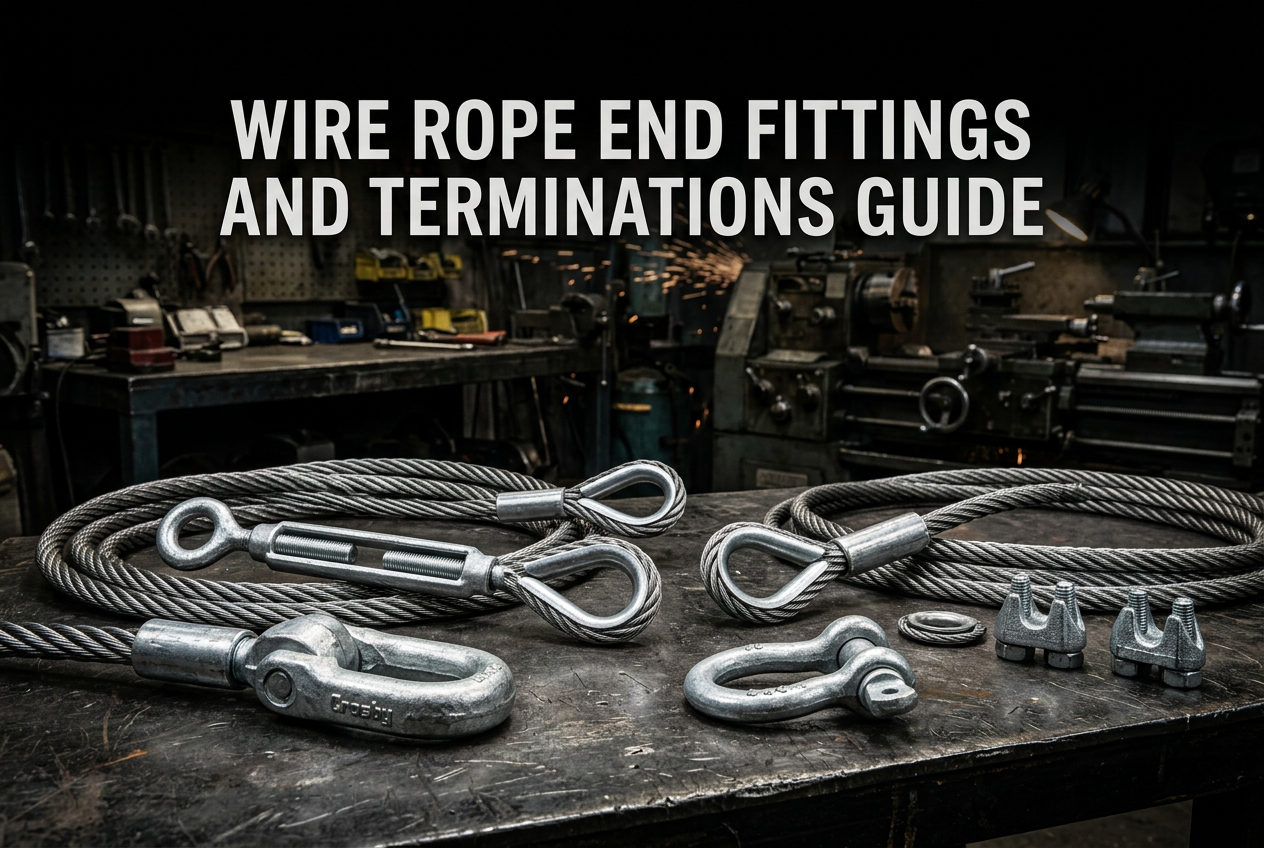
The most common wire rope end fittings are thimbles (protect rope at loops), ferrules/sleeves (secure loop terminations via swaging or crimping), turnbuckles (adjust tension), shackles (connect rope to anchor points), and wire rope clips (temporary connections). Choose fittings based on your load requirements, whether the connection is permanent or adjustable, and the environment (indoor vs marine).
Why Proper End Fittings Matter
Wire rope rarely fails in the middle of a straight run — it fails at the ends. Industry data shows that as much as 80% of wire rope failures occur at termination points, where the rope is bent, compressed, or clamped rather than left in its natural straight-line state. A termination is only as strong as the fitting used to make it, and the fitting is only as strong as the installation technique used to apply it.
Choosing the correct fitting — and installing it correctly — preserves the rope's rated strength. Get it wrong, and you can reduce the effective capacity of an otherwise sound rope by 20-50%, even though the rope itself tested to full specification. Before selecting a termination, it helps to know exactly what strength you are working with; see our wire rope breaking strength chart for rated loads by diameter and construction.
Thimbles
A thimble is a heart-shaped or round metal insert placed inside a loop of wire rope, sitting between the rope and whatever hardware — a shackle pin, hook, or eye bolt — passes through the loop.
Purpose
Without a thimble, a rope loop under tension collapses tightly around the connecting hardware, crushing the outer wires and creating a sharp bend radius that accelerates fatigue and wear. A thimble holds the loop open in a defined, gently curved shape, distributing the load evenly across the wires and preventing the rope from being pinched or abraded at the point of contact.
Materials
Thimbles are available in stainless steel (304 or 316) and hot-dip galvanized steel. Stainless thimbles should always be paired with stainless wire rope — mixing metals at a termination point invites galvanic corrosion right where the rope is most vulnerable. 316 thimbles are the standard choice for marine and coastal installations; 304 is adequate for general indoor and dry-climate use.
Sizing
A thimble must match the nominal diameter of the rope exactly. An oversized thimble allows the rope to shift and chafe against it; an undersized thimble will not seat properly inside the loop and leaves the rope unsupported at the bend. Always specify thimble size by rope diameter, not by the diameter of the hardware you intend to connect.
Ferrules and Swage Sleeves
Ferrules — also called sleeves — are compression fittings that permanently secure a loop by clamping the rope's tail back onto itself. They are the most common way to create a strong, permanent termination without tying knots or relying on friction alone.
Oval vs Round Sleeves
Oval sleeves are the standard choice for looped terminations: the rope passes through the sleeve twice (once out, once back through after forming the loop), and the sleeve is compressed flat around both sections. Round sleeves are typically used for single-pass, stop-style terminations where the rope only passes through once, such as setting a fixed stop on a cable.
Swaging vs Crimping
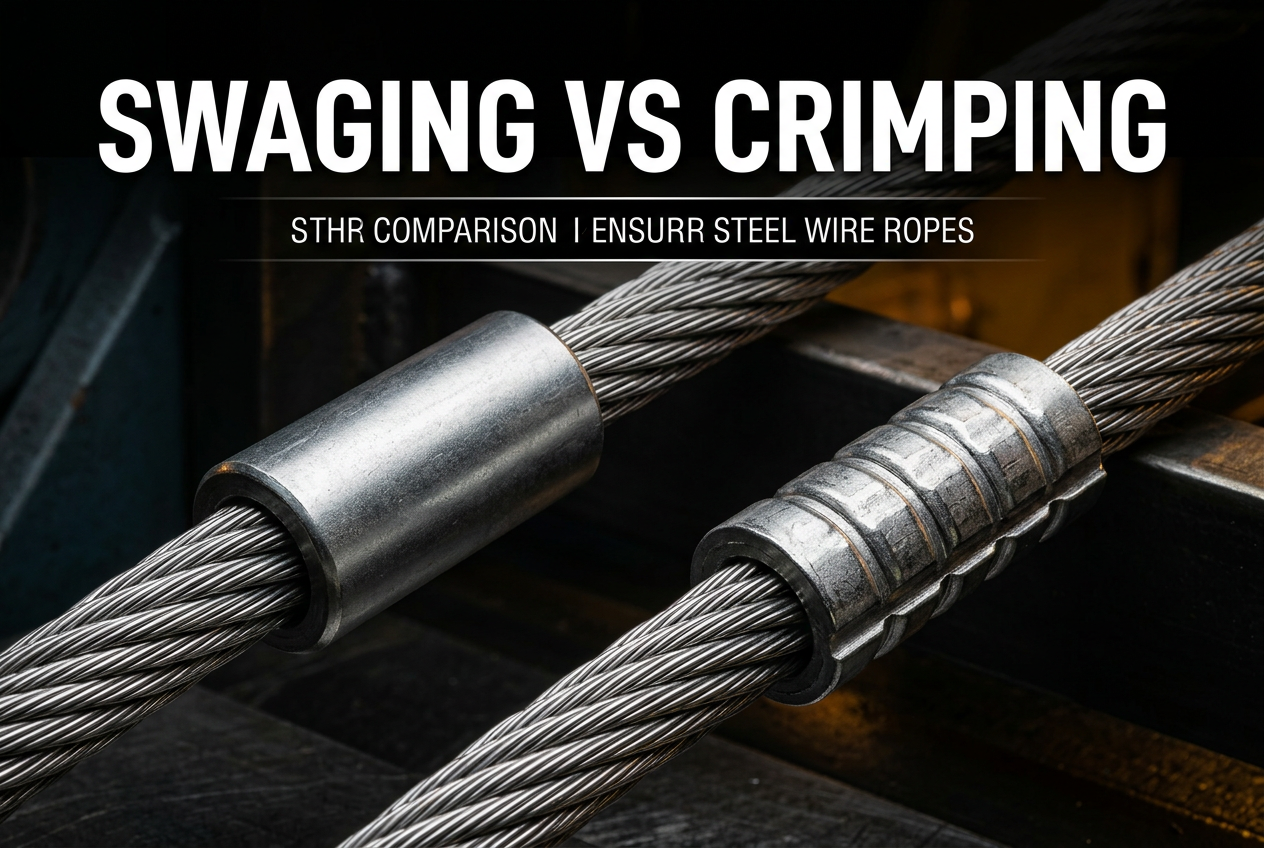
Swaging uses a hydraulic or mechanical press to compress the sleeve uniformly around the rope, achieving full, even contact between the sleeve and every wire. It is the stronger, more consistent method and is standard practice for load-bearing and safety-critical terminations. Crimping uses a hand tool to squeeze the sleeve at one or more points along its length. It is faster and requires no special equipment, but the compression is less uniform and the resulting joint is generally suited only to lighter-duty, non-critical applications. For a full breakdown of strength, cost, and when to use each method, see our swaging vs crimping guide.
Strength Retention
A properly swaged ferrule, applied with the correct sleeve size and press tonnage for the rope diameter, retains approximately 90-95% of the rope's rated breaking strength. Under-sizing the press, using the wrong sleeve, or skipping a swage pass are the most common causes of terminations that fail well below their expected rating. If strength retention and certification matter for your application, it is worth reviewing our guide to wire rope testing and certification to understand how swaged terminations are proof-tested.
Turnbuckles
A turnbuckle is an adjustable tensioning device with a threaded body and two end fittings, allowing the overall length of a wire rope assembly to be fine-tuned after installation.
Types
Turnbuckles are named by their end fitting configuration: jaw-jaw (a clevis fork at each end, ideal for direct pin connections), eye-eye (a solid loop at each end, commonly used with shackles or thimbled rope loops), jaw-eye (one of each, useful when connecting to different hardware types at either end), and hook-hook (open hooks at each end, favored for quick, non-permanent tensioning where safety factors allow).
Common Applications
Turnbuckles are essential wherever a cable run needs to be tensioned precisely after the structure is in place: cable railing and balustrade systems, sailboat standing rigging, fence and trellis tensioning, and static guy-wire supports. For rigging-specific guidance, see our overview of marine rigging applications.
Sizing Guide
A turnbuckle's Working Load Limit (WLL) must meet or exceed the working load limit of the wire rope it is paired with — the turnbuckle should never be the weak link in the assembly. As a rule, size the turnbuckle to the rope's rated capacity first, then verify the thread diameter and body length suit the physical connection points at both ends.
Wire Rope Clips (Crosby Clips)
Wire rope clips — often called Crosby clips or U-bolt clips — create a termination by clamping the rope's tail back against the standing part using a U-bolt, saddle, and two nuts.
Proper Installation
The single most important installation rule is: "never saddle a dead horse." The U-bolt (the part that looks like an upside-down "U") must always be placed on the short, unloaded tail end of the rope, while the saddle — the curved, load-bearing base — sits against the long, loaded standing part. Reversing this orientation crushes and damages the live side of the rope under load.
Number of Clips Required
The number of clips needed increases with rope diameter — small ropes typically need two clips, while larger diameters require three or more, each spaced roughly six rope diameters apart. Always consult the clip manufacturer's chart for your specific rope diameter, and torque each nut to the specified value.
Wire rope clips are appropriate for temporary rigging, guy wires, and non-critical tie-downs, but they are not recommended for critical lifting — a clipped termination typically retains only about 80% of rope strength and is prone to loosening under cyclic loading. For lifting and other safety-critical applications, use swaged fittings instead.
Shackles
A shackle is a U-shaped or D-shaped connector, closed by a removable pin, used to join a wire rope termination — typically a thimbled eye — to an anchor point, lifting hook, or other rigging hardware.
Types
Bow (omega) shackles have a wide, rounded body that tolerates loading from multiple angles, making them the more versatile general-purpose choice. D-shackles have a narrower, more rectangular body designed for straight, in-line loading; they are lighter for a given rating but less forgiving of side loads.
Pin Types
Screw pin shackles thread directly into the shackle body and are quick to install and remove, making them suited to connections that are reconfigured periodically. Bolt-type (bolt, nut, and cotter pin) shackles are more secure against vibration and accidental loosening, and are the preferred choice for permanent or safety-critical connections and overhead lifting.
Load Rating and Safety Factor
Every shackle is stamped with a Working Load Limit. As with turnbuckles, the shackle's WLL should meet or exceed the wire rope's working load limit so that the shackle is never the weakest point in the assembly. Never exceed the rated WLL, and never substitute an unrated or hardware-store shackle in a load-bearing application.
How to Choose the Right Fitting
With several fitting types capable of terminating the same rope, the right choice comes down to whether the connection needs to be permanent or adjustable, how much load it carries, and how critical the application is. Use the table below as a starting point:
| Application | Recommended Fitting | Strength Retention |
|---|---|---|
| Permanent loop (railing) | Thimble + Swage ferrule | 90-95% |
| Adjustable tension (rigging) | Turnbuckle + thimble | 85-90% |
| Temporary connection | Wire rope clips | 80% |
| Heavy lifting | Swage socket | 100% |
| Quick connect/disconnect | Shackle | N/A (rated by shackle) |
If you are still working out the rope specification itself — diameter, construction, or grade — before selecting terminations, our guide on how to choose wire rope walks through that process step by step.
Material Compatibility Warning
Always use stainless steel fittings with stainless steel wire rope. Mixing stainless steel rope with carbon-steel or galvanized fittings — or vice versa — sets up a galvanic couple between two dissimilar metals. In the presence of moisture, this accelerates corrosion at exactly the point where the rope is already under the most mechanical stress: the termination.
As a general rule, match the fitting grade to the rope grade and the environment: use 316 stainless fittings with 316 rope in marine or coastal installations, and 304 fittings with 304 rope for general indoor or dry-climate use. For a full breakdown of when each grade is appropriate, see our 304 vs 316 stainless steel guide.
Choosing the right end fitting — and matching its material and installation method to the rope and the application — is what turns a length of wire rope into a safe, load-rated assembly. If you need help specifying fittings for a specific project, contact our team for guidance.