Quick Answer
Most gym and fitness equipment uses nylon-coated 7x19 stainless steel wire rope in diameters from 3/16 inch (4.8mm) to 1/4 inch (6.4mm). The 7x19 construction provides the flexibility needed for pulley systems. Nylon coating protects against sweat corrosion and prevents user injury. When replacing gym cables, match the original diameter, construction, and coating exactly.
Why Wire Rope Is Used in Gym Equipment
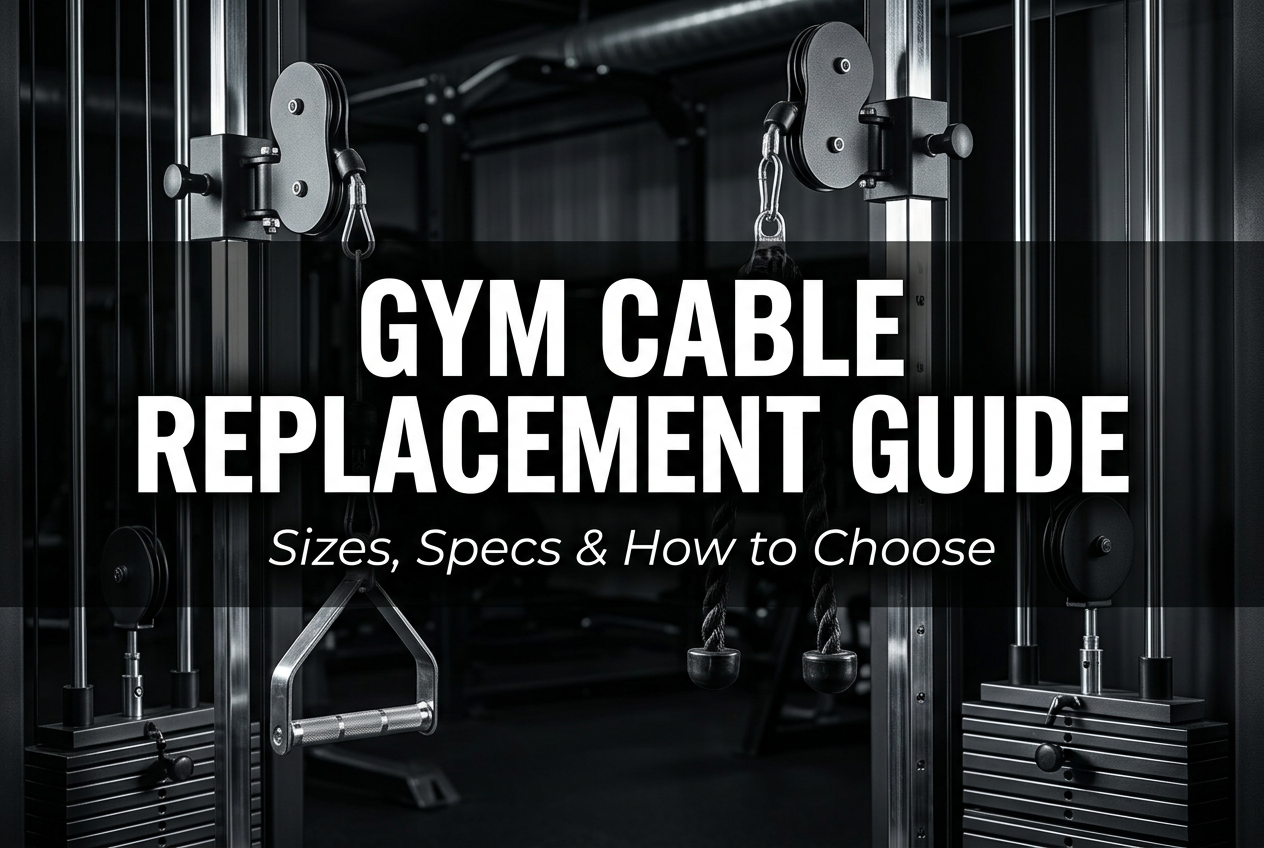
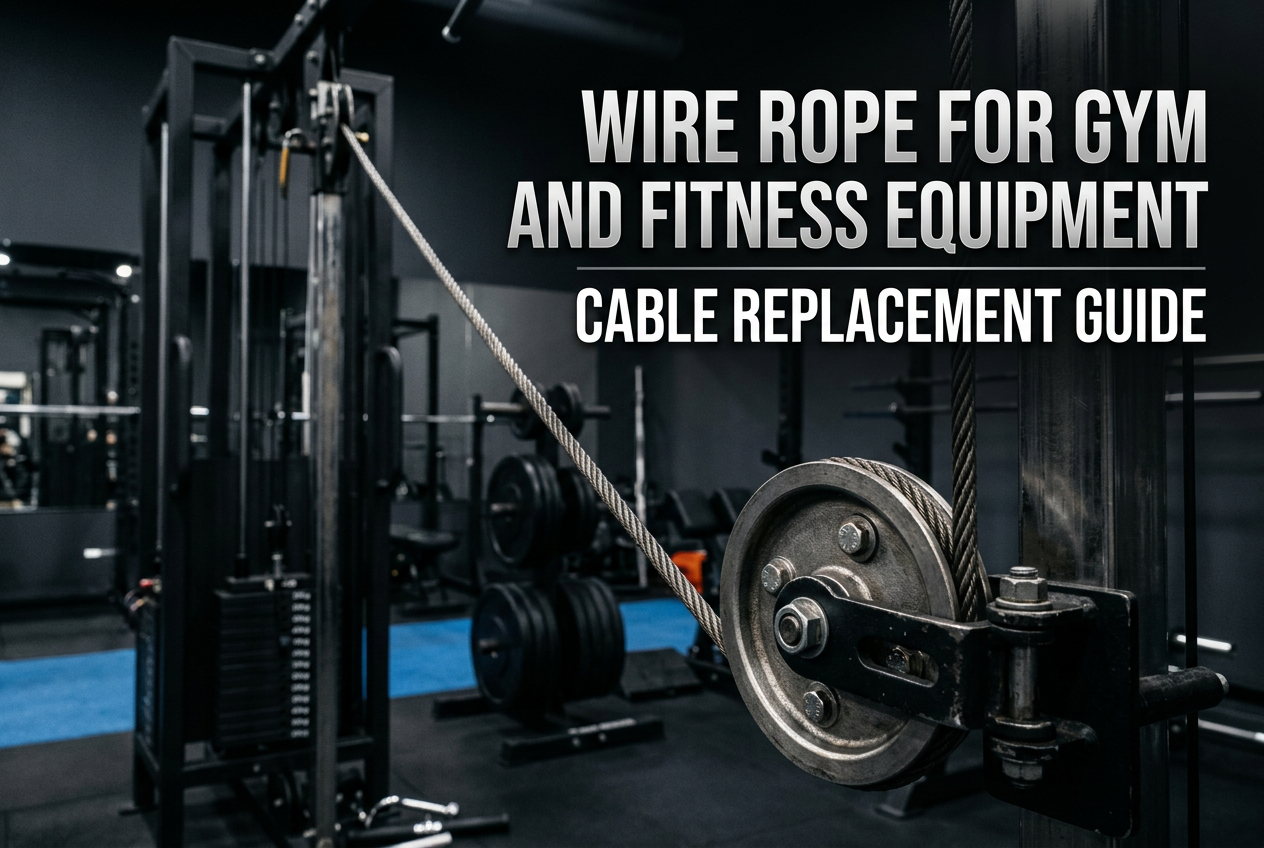
Inside a lat pulldown, cable crossover, or leg press machine, wire rope is the link between the weight stack and the handle or bar the user pulls. As the user moves the handle, the cable runs over a series of pulleys, redirecting force so the weight stack rises and falls smoothly.
That job places specific demands on the rope. It has to flex repeatedly around small-diameter pulleys without fatiguing, hold a smooth, snag-free surface that will not injure a user's hands, resist corrosion from sweat and humidity, and survive thousands of loading cycles per day in a busy commercial gym. Multi-strand, fine-wire constructions handle repeated bending far better than stiffer, coarser-wire ropes — for a deeper look at how strand count and wire count affect flexibility, see our 7x7 vs 7x19 construction comparison.
Common Gym Cable Specifications
While exact specifications vary by equipment brand and model, most machines fall into a predictable range of diameters and lengths:
| Equipment Type | Typical Diameter | Construction | Coating | Length |
|---|---|---|---|---|
| Lat pulldown | 3/16" (4.8mm) | 7x19 | Nylon | 3-5m |
| Cable crossover | 1/4" (6.4mm) | 7x19 | Nylon | 4-6m |
| Leg press cable | 3/16" (4.8mm) | 7x19 | Nylon | 2-4m |
| Smith machine | 5/32" (4.0mm) | 7x19 | Nylon | 3-4m |
| Home gym multi-station | 3/16" (4.8mm) | 7x19 | Nylon | 3-5m |
These figures are a starting point, not a substitute for the original manufacturer's specification. When replacing a cable, always confirm the exact diameter and length against the part you are removing — an undersized cable will be dangerously overloaded, and one that's too long or short won't route correctly through the pulley system. If you're replacing an existing cable rather than designing new equipment, our gym cable replacement guide walks through measuring your old cable, identifying its end fittings, and choosing the right size.
Why Nylon Coating Is Essential
Bare stainless steel wire rope is not the right choice for gym equipment, even though stainless resists corrosion better than carbon steel. Nylon coating is applied over the rope for several reasons specific to the fitness environment:
- Sweat protection: Human sweat contains salt and is mildly acidic, and it contacts gym cables constantly. A nylon jacket keeps moisture off the wires and out of the strand valleys, where corrosion would otherwise start.
- User safety: A smooth coated surface eliminates the risk of a broken wire end — a "meat hook" — snagging or cutting a user's hand, which is a real hazard on bare wire rope under repeated flexing.
- Reduced friction and longer life: The coating lowers friction against the pulley sheaves, which reduces wear on both the cable and the pulleys and extends the service life of the whole system.
- Color options: Coated cable is commonly available in clear, black, and white, letting equipment manufacturers match cable appearance to the machine's finish.
Nylon coating sits on top of the base metal, so the choice of coating doesn't replace the need for a corrosion-resistant core wire. For a broader comparison of how different base materials and finishes hold up over time, see our stainless steel vs galvanized comparison.
304 vs 316 for Gym Applications
304 stainless steel is sufficient for the vast majority of indoor gym environments. Under a nylon coating, in a climate-controlled facility, 304-grade rope gives years of reliable service at a lower material cost.
316 stainless steel is worth the upgrade for outdoor fitness equipment, poolside or spa-adjacent gyms, and coastal facilities where humidity and airborne salt are higher. The added molybdenum in 316 gives it meaningfully better resistance to pitting and chloride exposure, which matters more once equipment sits outside the controlled indoor environment.
For a typical gym cable length, the price difference between 304 and 316 is a small fraction of the total cost of the machine, so the decision usually comes down to the installation environment rather than budget. Our 304 vs 316 stainless steel guide covers the full cost and performance trade-off in detail.
How to Replace a Gym Cable (Step by Step)
- Identify the cable specification. Note the diameter, overall length, and the type of end fittings (ball ends, threaded studs, or swaged loops) before ordering a replacement.
- Remove the old cable. Release tension on the weight stack, detach the end fittings from the handle and weight carriage, and carefully thread the old cable back out of each pulley.
- Measure the new cable. Use the old cable as a reference and add roughly 10-15cm of extra length to account for material consumed during swaging or crimping the end fittings.
- Thread the new cable through all pulleys. Follow the exact routing of the original cable, making sure it seats correctly in every pulley groove with no crossed or pinched sections.
- Attach end fittings. Swage or crimp ferrules onto the cable ends, using thimbles at any loop to protect the rope from sharp bending. Correct fitting selection and installation are critical to retaining the cable's rated strength — see our wire rope end fittings guide for details on each fitting type.
- Test with light weight before full use. Run the machine through its full range of motion with a light load first, checking that the cable tracks correctly on every pulley and that both end fittings are secure, before returning the machine to normal use.
Signs Your Gym Cable Needs Replacement
Gym cables see heavy cyclic use and should be inspected regularly. Replace a cable immediately if you notice any of the following:
- Visible broken wires — even a single broken wire is a reason to replace the cable, not just monitor it.
- Coating damage or peeling — exposed bare wire beneath a torn nylon jacket will corrode and weaken rapidly.
- Cable stretching — a noticeable change in weight stack travel distance often indicates the cable has permanently stretched.
- Rust or discoloration — any sign of corrosion means moisture has reached the wires and the rope's strength can no longer be trusted.
- Fraying near pulleys or fittings — the areas of highest bending stress are where fatigue damage shows up first.
A brief but consistent inspection routine catches most of these issues before they become safety incidents. Our wire rope inspection checklist walks through what to check and how often.
Breaking Strength and Safety Factor
Gym cables should be specified with a minimum 5:1 safety factor — meaning the cable's rated breaking strength should be at least five times the maximum load it will ever see in service.
For example, a machine with a 100kg weight stack requires a cable with a minimum breaking strength of 500kg. A 3/16" (4.8mm) 7x19 stainless steel cable has a breaking strength of roughly 1,700kg, giving a safety factor well above 5:1 for most consumer and light commercial machines. Heavier commercial stacks or multi-cable pulley systems may call for a larger diameter to maintain the same margin. For exact figures across every diameter and construction, consult our complete breaking strength chart.
Ordering Custom Gym Cables
We supply pre-cut, pre-coated wire rope for gym and fitness equipment with end fittings attached and ready to install, so equipment manufacturers and service providers don't need to handle swaging in-house.
- Pre-cut, pre-coated cables in the diameters and lengths used across common gym equipment, with fittings attached to your specification.
- Minimum order quantities tailored to equipment manufacturers, from prototype runs to full production volumes.
- Custom coating colors — clear, black, white, or a color matched to your equipment's branding.
- OEM packaging available for equipment brands that need cables ready to ship under their own labeling.
If you manufacture or service fitness equipment and need gym cables built to a specific diameter, length, or coating, contact our team with your specification and we'll help you source the right cable.