Quick Answer
Most gym equipment uses 3/16" (5mm) or 1/4" (6mm) 7x19 stainless or galvanized wire rope with a clear nylon/PVC coating (finished OD 1/4" to 5/16"). Breaking strength ranges from 3,900 to 6,100 lbs — far above the working loads of weight stacks. Replace cables at the first sign of fraying, coating cracks, or kinks.
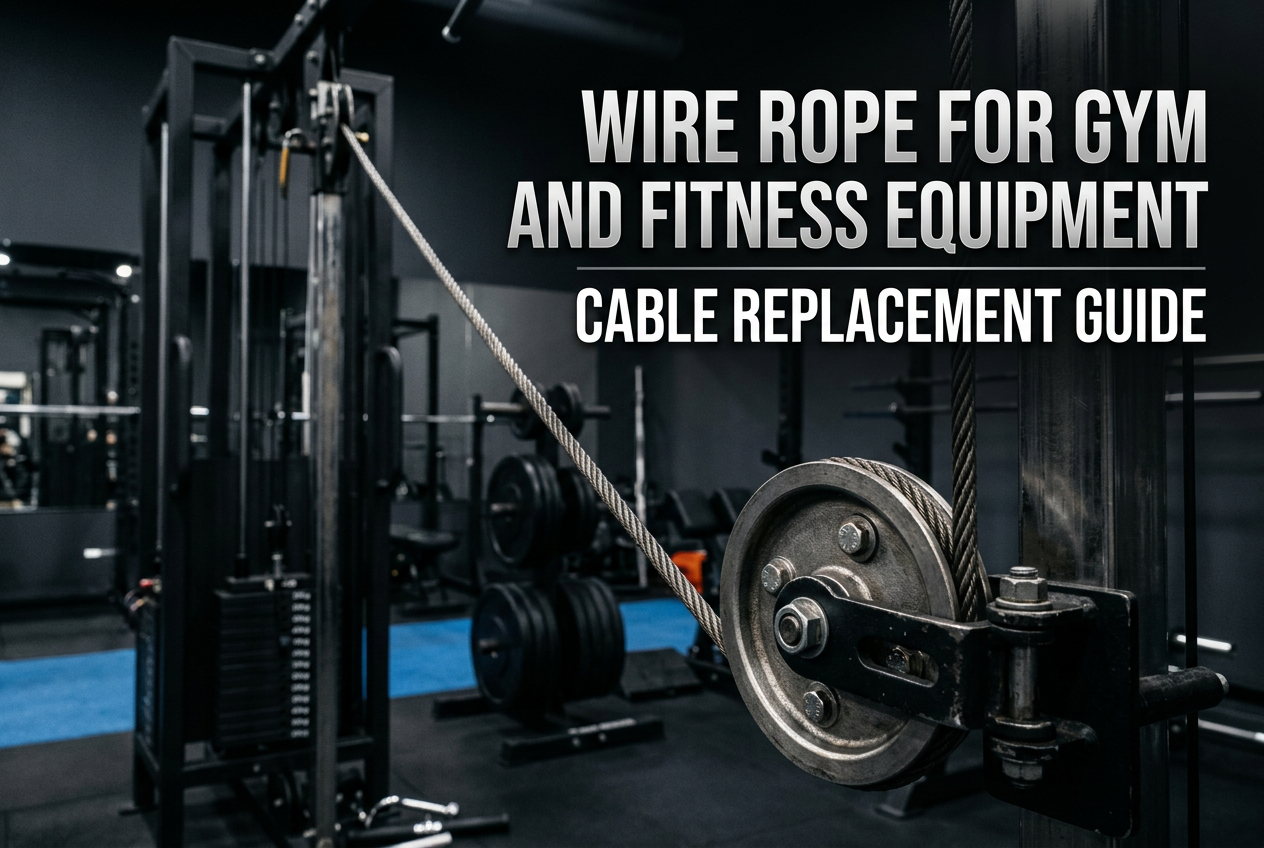
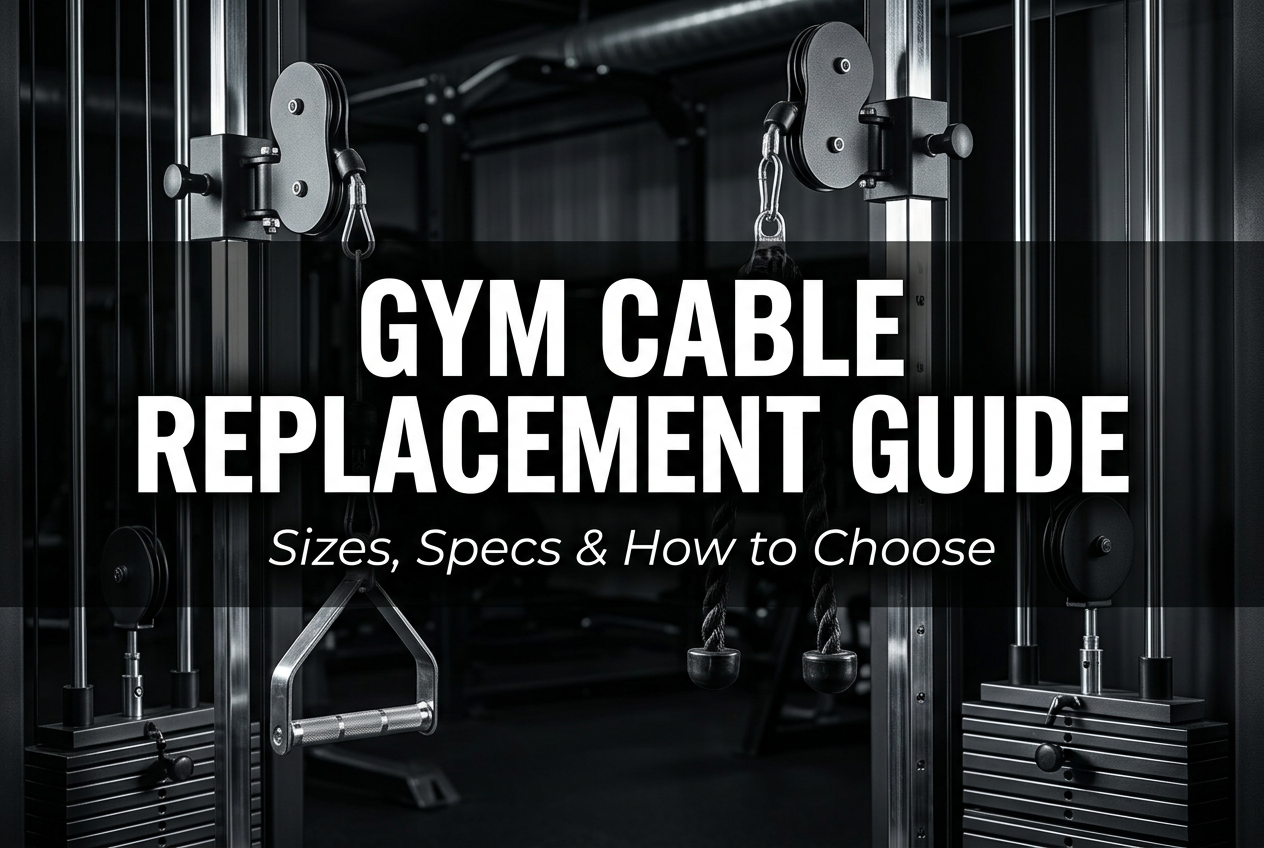
Whether you maintain a commercial gym floor, refurbish used equipment for resale, or run a home gym in your garage, sooner or later a cable wears out. This guide covers everything you need to order the right replacement: standard sizes, why 7x19 construction dominates, coating and material choices, how to measure your old cable, and the end fittings you'll encounter. If you're an equipment manufacturer choosing cable specifications from scratch, our wire rope for gym and fitness equipment guide approaches the same topic from the design side.
Standard Gym Cable Sizes & Constructions
Gym cables cluster around a handful of sizes. The table below lists the bare rope diameter (the steel itself), the typical coated outside diameter, and the minimum breaking strength of the bare rope at the standard 1770 MPa grade:
| Typical Equipment | Bare Rope Diameter | Coated OD | Construction | Breaking Strength |
|---|---|---|---|---|
| Home gym multi-station, Smith machine | 5/32" (4.0mm) | 3/16" (4.8mm) | 7x19 | ~2,500 lbs (11.1 kN) |
| Lat pulldown, leg press, functional trainer | 3/16" (5.0mm) | 1/4" (6.4mm) | 7x19 | ~3,900 lbs (17.4 kN) |
| Cable crossover, heavy commercial stacks | 1/4" (6.0mm) | 5/16" (8.0mm) | 7x19 | ~5,600 lbs (25.1 kN) |
| Light accessories (ab straps, small pulleys) | 1/8" (3.2mm) | 3/16" (4.8mm) | 7x19 | ~1,600 lbs (7.1 kN) |
Even the smallest common size carries several times the load of any weight stack. A full 200 lb stack loads a 3/16" cable to barely 5% of its breaking strength — gym cables fail from bending fatigue and wear, not from overload. For exact figures across every diameter and construction, see our complete breaking strength chart.
Why 7x19 Is the Standard for Gym Cables
Virtually every gym cable is 7x19 construction: 7 strands of 19 wires each, 133 wires in total. The reason is bending fatigue. A gym cable runs over multiple small pulleys and flexes through thousands of cycles per week — the single most demanding bending application small-diameter wire rope sees.
The many fine wires of 7x19 slide against each other as the rope bends, letting it wrap small sheaves without overstressing any individual wire. Stiffer constructions like 7x7 or 1x19 would develop fatigue-broken wires at the pulleys within months. If a supplier offers you 7x7 cable for a pulley machine as a cheaper substitute, decline — it will not last.
Coated vs Uncoated: Why Coating Matters
Gym cables are almost always jacketed in clear nylon or PVC, and the coating does real work:
- Quiet, smooth operation: the plastic jacket runs silently over pulley sheaves and protects both the sheave grooves and the rope from wear.
- Sweat protection: sweat is salty and mildly acidic, and its chlorides attack steel — even stainless grades under the wrong conditions, as we explain in does stainless steel wire rope rust? The jacket keeps sweat out of the strand valleys where corrosion starts.
- Hand safety and feel: a coated cable can never present a broken wire end to a user's hand, and it looks and feels finished on the gym floor.
One caution: the coating hides the steel underneath. Once the jacket cracks or peels, moisture gets trapped against the rope and corrosion accelerates — a damaged coating is itself a replacement trigger, not just a cosmetic flaw.
Stainless vs Galvanized for Gym Use
Under the coating, the rope is either galvanized carbon steel or stainless steel, and the right choice depends on the environment:
- Galvanized is perfectly adequate for home gyms and dry, climate-controlled facilities. It is 30–50% cheaper and, at equal diameter, slightly stronger than stainless. Most OEM cables on consumer equipment are galvanized under the jacket.
- Stainless (304) is the better choice for busy commercial gyms, humid climates, poolside or spa-adjacent facilities, and outdoor fitness rigs — anywhere sweat volume or ambient moisture will eventually find its way through nicks in the coating.
For the full cost and corrosion trade-off between the two materials, see our stainless steel vs galvanized wire rope comparison.
How to Measure Your Old Cable
Ordering the wrong size is the most common replacement mistake, and it usually comes down to measuring the wrong thing. Three measurements matter:
- Core diameter vs coated OD. Suppliers list cable by the bare steel diameter, but calipers on an intact cable read the coated outside diameter. Measure the bare steel at a cut end or where the coating is stripped back at a fitting — or subtract the typical jacket wall (roughly 1/32" per side). A cable that reads 1/4" over the coating is almost always 3/16" steel.
- Length, fitting to fitting. Pull the old cable straight and measure from the bearing point of one end fitting to the bearing point of the other — not just the visible rope. If the old cable has stretched or been cut, check the equipment manual's part specification instead.
- Count and identify the end terminals. Note what is on each end (ball, stud, eyelet), its dimensions, and its orientation before you order. A photo of each end next to a ruler saves a round of back-and-forth with any supplier.
End Fittings on Gym Cables
Three terminations cover nearly all gym equipment:
- Ball stop (ball shank): a swaged steel ball that seats in a slotted bracket on the weight stack or handle carriage — the most common gym termination. Measure ball diameter and, for ball-and-shank types, the shank length.
- Threaded stud: a swaged stud (commonly 3/8"-16 or M10) that screws into the weight stack's top plate or an adjuster, allowing cable tension to be fine-tuned.
- Eyelet / swaged loop: a loop formed around a thimble and secured with a swaged ferrule, used to connect to pulleys, carabiners, or handle hardware.
Factory-swaged fittings retain essentially the rope's full strength; hand-crimped field repairs often don't. Our wire rope end fittings guide covers every termination type, its strength rating, and how each is installed.
When to Replace: 5 Warning Signs
Replace a gym cable immediately if you see any of the following:
- Fraying or broken wires — visible as fuzz or bumps under the coating, most often near pulleys. Even one broken wire means the fatigue process is under way.
- Coating cracks, splits, or peeling — exposed steel corrodes fast under trapped sweat, and the damage is hidden until it's severe.
- Kinks or flattened sections — a kink permanently deforms the strands and creates a weak point that no amount of tensioning fixes.
- Rust stains bleeding through the jacket — corrosion has already reached the wires; the rope's remaining strength is unknown.
- Noticeable stretch or changed stack travel — permanent elongation means the rope's internal structure is degrading.
A two-minute monthly check catches all five before they become an injury. Our wire rope inspection checklist turns this into a repeatable routine for a whole equipment floor.
Bulk Ordering for Gym Equipment Manufacturers & Refurbishers
If you build, service, or refurbish fitness equipment at volume, buying finished cable assemblies beats swaging in-house: consistent swage quality, per-piece test traceability, and no capital tied up in swaging equipment. As a wire rope manufacturer, we supply gym cable assemblies built to your specification:
- Cut-to-length assemblies with ball stops, threaded studs, or eyelets swaged to your drawing — ready to install out of the box.
- Coating options: clear, black, white, or custom colors matched to your equipment line, in nylon or PVC, with the coated OD held to your tolerance.
- Material choice of galvanized or 304/316 stainless core rope, with mill test certificates on every batch.
- Flexible MOQs — from a refurbisher's mixed box of common sizes to full OEM production runs with private-label packaging.
Send us a sample cable or a drawing with diameter, length, fittings, and coating color, and we'll quote within 24 hours — contact our team to get started.
Frequently Asked Questions
What size cable do gyms use?
Most commercial gym machines use 3/16" (5mm) or 1/4" (6mm) 7x19 wire rope with a clear nylon or PVC coating that brings the finished outside diameter to 1/4"–5/16". Home gyms and Smith machines often use 5/32" (4mm) cable, and light accessories use 1/8" (3.2mm). Always confirm against the original cable — suppliers list the bare steel diameter, not the coated one.
Can I replace gym cables myself?
Yes, if you buy a pre-made assembly with the fittings already swaged on. Release the weight stack tension, photograph the cable routing, thread the new cable through the same pulley path, attach the end fittings, and test through the full range of motion with a light load first. What you should not do is swage fittings yourself with hand crimpers — a factory swage retains the rope's full strength, while an improvised crimp may not.
How long do gym cables last?
In a busy commercial gym, cables on high-traffic machines typically last 1–3 years; in a home gym, 5–10 years is common. Lifespan is driven by bending cycles over the pulleys, not by the weight lifted, so the same cable lasts far longer on a lightly used machine. Monthly visual inspection matters more than any calendar interval.
Should I measure the coated or bare diameter when ordering?
Order by the bare steel diameter — that is how wire rope is specified and how breaking strength is rated. Measure the steel at a cut end or stripped section, or subtract the jacket thickness (roughly 1/16" total) from the coated reading. A cable measuring 1/4" over the coating is usually 3/16" steel, and one measuring 5/16" is usually 1/4" steel.
Are gym cables stainless steel or galvanized?
Both are used. Most factory cables on consumer equipment are galvanized carbon steel under the coating, which is fine for dry indoor use. Stainless steel (304) costs more but resists sweat and humidity better, making it the safer choice for commercial gyms, humid climates, and poolside or outdoor installations.