Quick Answer
Aircraft cable and wire rope are constructed the same way — the difference is size and terminology. "Aircraft cable" refers to small-diameter (typically 3/32" to 3/8") 7x7 or 7x19 stranded cable, a naming convention from early aviation controls. Despite the name, modern aircraft cable is used for railings, exercise equipment, garage doors, and rigging — not aircraft. For corrosive environments, choose stainless steel (304 or 316) over galvanized aircraft cable.
Search for "aircraft cable" on any North American hardware site and you will find spools of thin, flexible steel cable sold for deck railings, garage door repairs, and gym machines. Search for "wire rope" and you will find — in many cases — exactly the same product under a different name. The two terms confuse buyers constantly: some assume aircraft cable is a special aviation-certified material, others assume wire rope means only the thick cables on cranes.
This guide clears up the terminology, explains where the name "aircraft cable" actually came from, and then covers everything you need to buy the right cable: 7x7 vs 7x19 construction, stainless steel vs galvanized, standard imperial sizes with breaking strengths, typical applications, and what MIL-SPEC certification does (and does not) mean for your project.
What Is Aircraft Cable?
Aircraft cable is small-diameter stranded steel cable — usually 7x7 or 7x19 construction in diameters from 1/16" to 3/8" — made from galvanized carbon steel or stainless steel. The name is historical, not functional. In the early decades of aviation, flight control surfaces — ailerons, elevators, rudders — were operated by thin steel cables running over pulleys from the cockpit controls, and biplane wings were braced with similar stranded wire. Those control cables needed to be strong for their size yet flexible enough to wrap around small pulleys, which is exactly what the 7x7 and 7x19 constructions deliver.
The constructions standardized for aviation proved just as useful on the ground, and the aviation name stuck. Today, well over 99% of the "aircraft cable" sold goes nowhere near an airplane: it tensions cable railings, lifts garage doors, drives weight stacks in gyms, rigs sailboats, and secures trailers. Genuine aviation use requires cable certified to a military specification — covered in the MIL-SPEC section below — but the everyday product is simply small, flexible wire rope.
Aircraft Cable vs Wire Rope: Terminology Explained
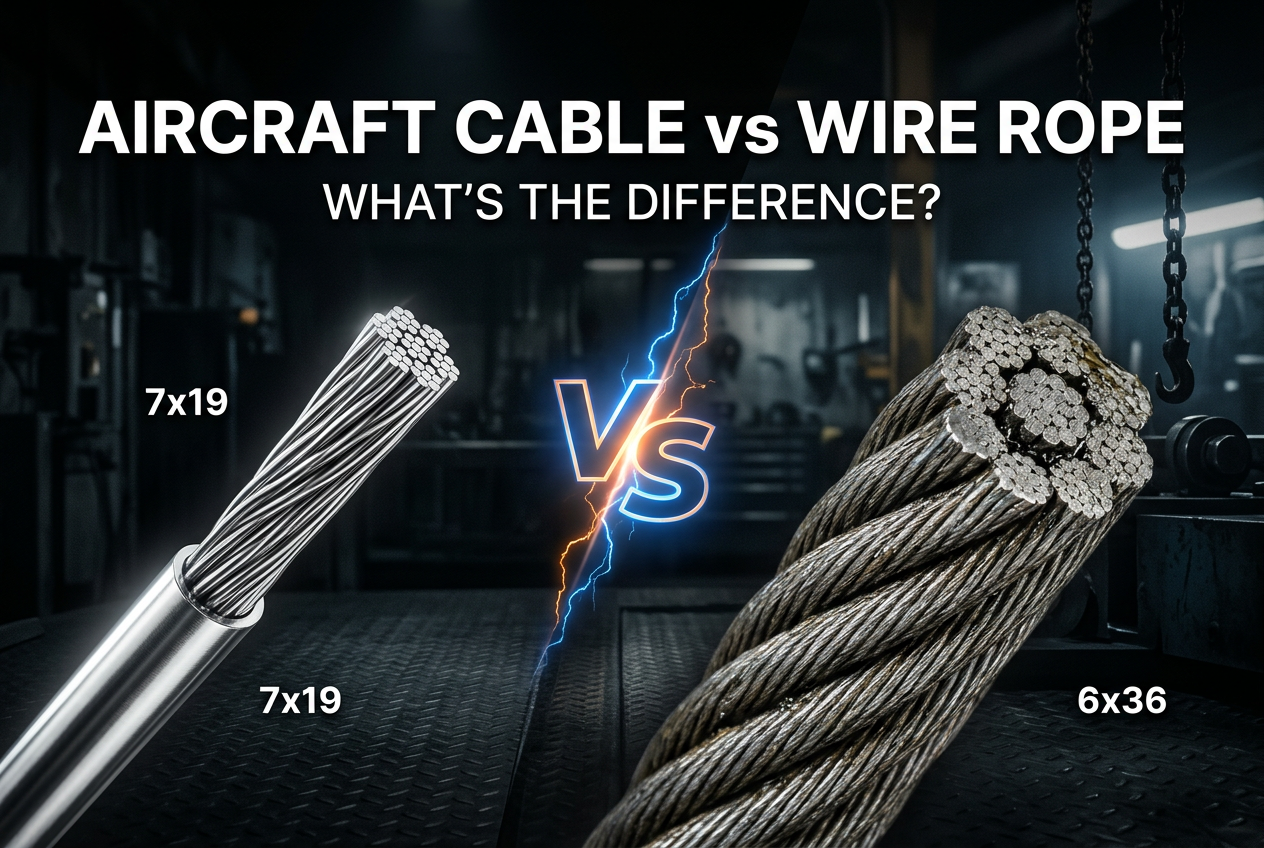
Structurally, there is no difference: both are wires twisted into strands and strands twisted around a core. The distinction is a North American naming convention based on diameter:
| Term | Where It's Used | What It Usually Means |
|---|---|---|
| Aircraft cable | North America (US & Canada) | Small-diameter stranded cable, typically 3/32" to 3/8" (2.4–9.5mm), in 7x7 or 7x19 construction |
| Wire rope | Worldwide | Any stranded steel rope; in North American trade, usually diameters of 3/8" (10mm) and up |
| Cable / steel cable | Worldwide | Generic term, used interchangeably with both of the above |
| Strand (e.g., 1x19) | Industry / engineering | A single strand of wires with no separate core — technically not a "rope" at all |
The industry rule of thumb: below 3/8" diameter it's called cable, at 3/8" and above it's called wire rope. The boundary is informal — you will see 3/8" product listed both ways — but it explains why a US supplier's "1/8 inch aircraft cable" and an international supplier's "3.2mm 7x7 stainless steel wire rope" are the same item. Outside North America, the term "aircraft cable" is rarely used at all; metric-market catalogs list everything as wire rope or steel cable by millimeter diameter. If you are importing from an overseas manufacturer, specify the construction and diameter rather than the trade name and there will be no ambiguity.
Common Aircraft Cable Constructions: 7x7 vs 7x19
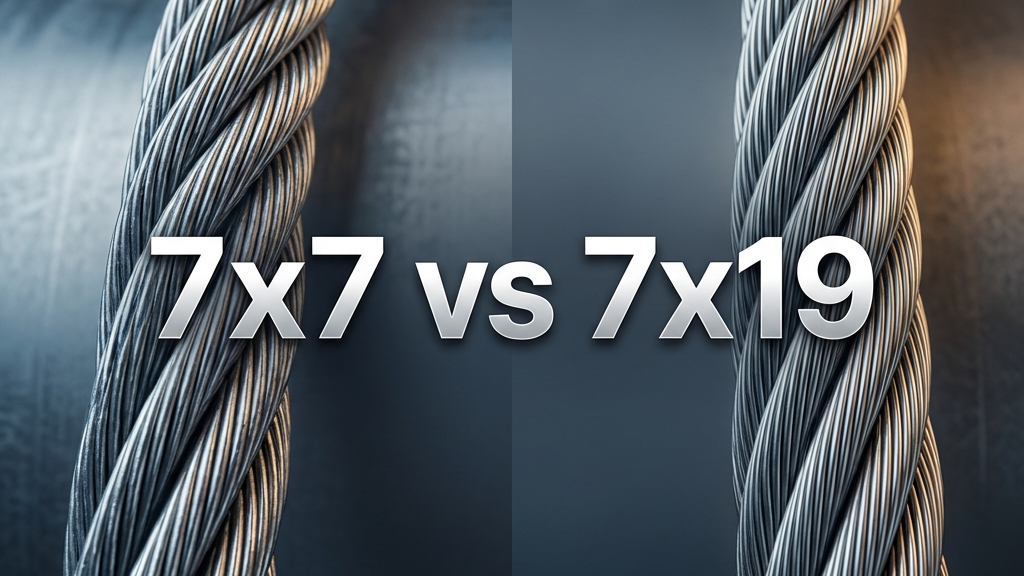
The construction code tells you how the cable is built: 7x7 means 7 strands of 7 wires each (49 wires total), while 7x19 means 7 strands of 19 wires each (133 wires total). More, thinner wires make a cable more flexible; fewer, thicker wires make it more abrasion-resistant and slightly stronger for the same diameter:
| Feature | 7x7 Aircraft Cable | 7x19 Aircraft Cable |
|---|---|---|
| Total wires | 49 | 133 |
| Flexibility | Moderate | High — best for pulleys and winches |
| Abrasion resistance | Better (thicker outer wires) | Lower (thinner outer wires) |
| Breaking strength (same diameter) | Slightly higher | Slightly lower |
| Common size range | 1/16" – 3/32" (also up to 3/8") | 1/8" – 3/8" |
| Typical uses | Cable railings, security cables, push-pull controls, static rigging | Garage doors, gym equipment, winch lines, running rigging — anything over a pulley |
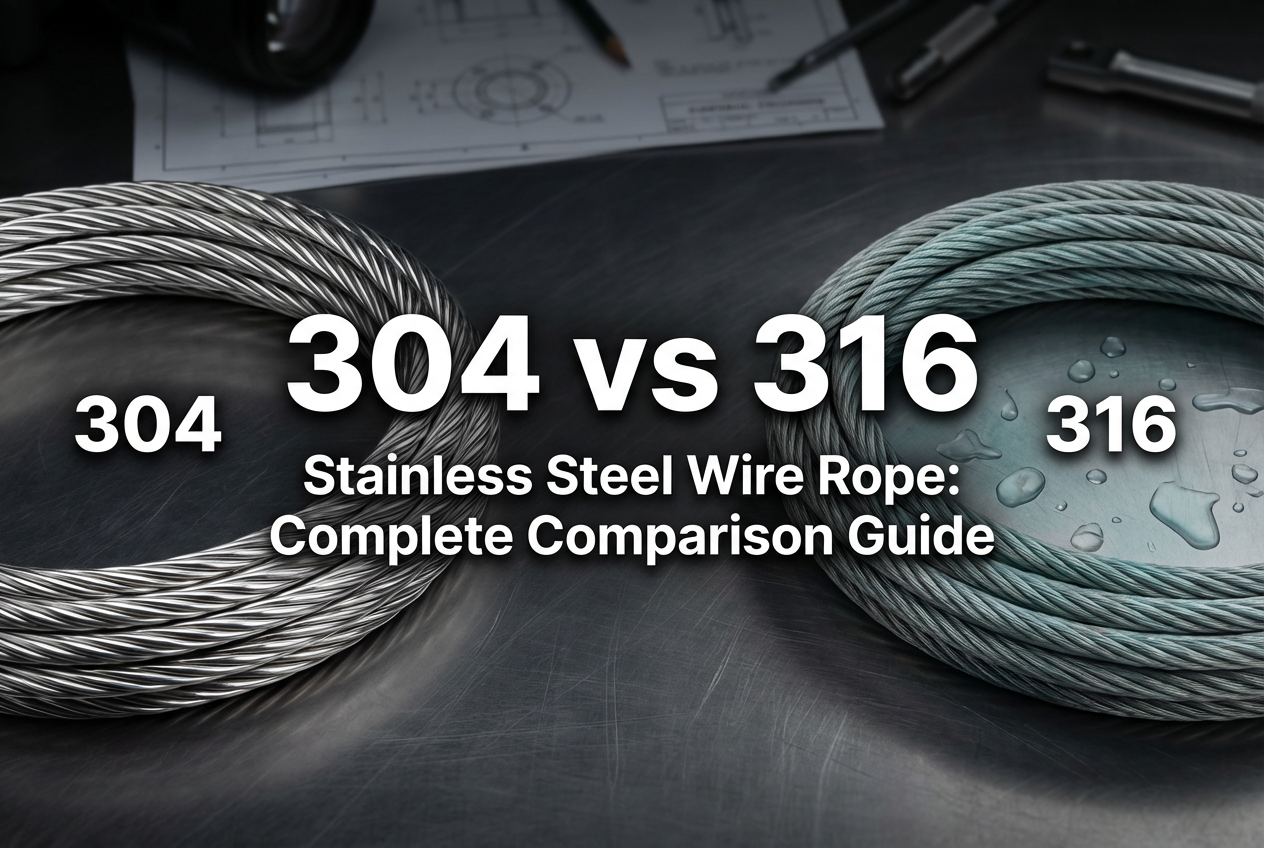
The selection rule is simple: if the cable bends repeatedly in service — over a pulley, around a drum, through a weight-stack machine — choose 7x19. If it stays mostly static, choose 7x7 for its better wear resistance and marginally higher strength. In the smallest diameters (1/16" and 3/32"), 7x7 dominates because 19-wire strands would require impractically fine wires. For a deeper comparison including bend radius limits and fatigue behavior, see our full guide to 7x7 vs 7x19 wire rope construction.
Stainless Steel vs Galvanized Aircraft Cable
Aircraft cable is stocked in three common materials: galvanized carbon steel and stainless steel types 304 and 316. Galvanized costs the least and is fine in dry service; stainless resists corrosion through its alloy rather than a sacrificial coating, so it keeps protecting even where the surface is worn:
| Property | 304 Stainless | 316 Stainless | Galvanized Steel |
|---|---|---|---|
| Corrosion resistance | Good — handles rain and humidity | Excellent — resists salt water and pool chemicals | Fair — zinc layer protects until it wears or scratches through |
| Relative strength | High (1770 MPa grade available) | High — comparable to 304 | Slightly higher than stainless at the same size |
| Relative cost | Medium | Highest (about 20–30% over 304) | Lowest |
| Appearance over time | Stays bright | Stays bright, even coastal | Dulls, then white rust, then red rust |
| Best environments | Indoor, dry outdoor, architectural | Marine, coastal, poolside, chemical exposure | Dry indoor, budget projects, frequently replaced cables |
For anything permanently outdoors — railings, marine rigging, exterior shade structures — the long-term economics favor stainless: a galvanized cable that must be replaced every few years quickly costs more than a 316 cable that lasts decades. For garage doors and other dry, sheltered mechanisms, galvanized 7x19 remains the sensible default. Our detailed stainless steel vs galvanized wire rope comparison covers lifespan data, coating behavior, and cost breakdowns for each material.
Standard Aircraft Cable Sizes & Breaking Strength
North American aircraft cable is sold in imperial sizes from 1/16" to 3/8". The table below lists each size with its nearest standard metric equivalent and the minimum breaking strength for 7x7 and 7x19 stainless steel constructions at the 1770 MPa tensile grade (per GB/T 9944-2015 — the same data as our complete wire rope breaking strength chart):
| Imperial Size | Nearest Metric | 7x7 Min. Breaking Strength | 7x19 Min. Breaking Strength |
|---|---|---|---|
| 1/16" | 1.5 mm | 382 lbs (1.70 kN) | 352 lbs (1.57 kN) |
| 3/32" | 2.5 mm | 1,060 lbs (4.71 kN) | 978 lbs (4.35 kN) |
| 1/8" | 3.2 mm | 1,735 lbs (7.72 kN) | 1,603 lbs (7.13 kN) |
| 5/32" | 4.0 mm | 2,713 lbs (12.07 kN) | 2,504 lbs (11.14 kN) |
| 3/16" | 5.0 mm | 4,238 lbs (18.86 kN) | 3,912 lbs (17.40 kN) |
| 1/4" | 6.0 mm | 6,103 lbs (27.15 kN) | 5,633 lbs (25.06 kN) |
| 5/16" | 8.0 mm | 10,851 lbs (48.27 kN) | 10,011 lbs (44.53 kN) |
| 3/8" | 10.0 mm | 16,954 lbs (75.42 kN) | 15,642 lbs (69.59 kN) |
Two cautions when reading any breaking strength table. First, these are minimum breaking strengths for new cable — never working loads. Divide by a safety factor (5:1 for lifting, 4:1 for railings, 10:1 wherever people are involved) to get the load the cable may actually carry. Second, metric equivalents here are the nearest standard metric diameter, and strengths are quoted for that metric size; cable made to an imperial specification (such as MIL-DTL-83420) has its own published minimums that differ slightly. Always confirm the certified breaking strength on the manufacturer's test certificate for your actual product.
Typical Applications
Despite the aviation name, aircraft cable earns its keep in everyday structures and machines. The most common uses, and what to specify for each:
- Cable railing. The single biggest architectural use. Railing systems use 1/8" or 3/16" cable tensioned between posts — though for straight runs, stiffer 1x19 strand holds tension even better than 7x7. Our cable railing wire rope guide covers construction choice, code requirements, and hardware in detail.
- Garage door lift cables. Typically 1/8" or 3/32" galvanized 7x19, which flexes around the drums on every cycle. Doors cycle thousands of times a year, so this is a classic fatigue application — inspect and replace at the first broken wire.
- Gym and fitness equipment. Weight-stack machines and functional trainers run 3/16" or 1/4" 7x19 cable — usually nylon-coated — over small pulleys. See our guide to wire rope for gym and fitness equipment for specifications and replacement steps.
- Marine rigging. Lifelines, halyards, davit lines, and dinghy rigging use 316 stainless 7x7 and 7x19 in the 1/8"–1/4" range, where salt exposure rules out galvanized.
- Winch cables. ATV, utility, and light-duty trailer winches run 3/16" to 3/8" 7x19, which tolerates repeated spooling onto a small drum.
- Trailer safety cables. Breakaway and safety cables in 1/8"–3/16" sizes, usually galvanized with swaged loop ends — a static application where 7x7 works well.
MIL-SPEC Standards Explained
When aircraft cable genuinely goes on an aircraft, it must meet MIL-DTL-83420(formerly MIL-W-83420), the US military detail specification for flexible wire rope used in aircraft control systems. The specification defines permitted constructions (7x7 for the smallest diameters, 7x19 from 1/8" up), materials (coated carbon steel or corrosion-resistant steel), minimum breaking strengths per size, and — critically — an endurance requirement: sample cable must survive a specified number of cycles flexing over sheaves under load without failure. Every production lot is proof-tested and fully traceable.
Commercial-grade aircraft cable uses the same constructions and similar wire, but is not lot-tested to the MIL-SPEC fatigue and traceability requirements, which is why it costs a fraction of certified cable. The practical guidance:
- Actual aircraft controls, or contracts that cite the spec: only certified MIL-DTL-83420 cable with documentation is acceptable. No substitutions.
- Railings, garage doors, gyms, rigging, general hardware: commercial-grade cable is the correct, economical choice. Paying for MIL-SPEC certification buys you paperwork your application doesn't need — what matters instead is a manufacturer's test certificate showing the actual breaking strength of your lot.
One caution: some retailers use "mil-spec type" or "MIL-DTL-83420 equivalent" loosely to describe commercial cable of the same construction. If your application legally requires the specification, insist on certification documents, not "equivalent" wording.
How to Order Aircraft Cable from a Manufacturer
Because "aircraft cable" means different things to different suppliers, the reliable way to get exactly what you need is to specify five parameters explicitly:
- Construction — 7x7 for static runs and abrasion resistance, 7x19 for anything over pulleys. (For straight architectural runs, also consider 1x19 strand.)
- Diameter — imperial or metric, but state which: "1/8 inch (3.2mm)" removes all doubt with an overseas manufacturer.
- Material and grade — galvanized carbon steel, stainless 304, or stainless 316; add the tensile grade (e.g., 1770 MPa) if your load calculation depends on it, plus any coating (PVC or nylon jacket, and jacketed OD).
- Length and packaging — total meters/feet, reel sizes, and whether you need cut-to-length pieces.
- Termination — bare cut ends, or factory-swaged eyes, ferrules, studs, and turnbuckles. Factory swaging is stronger and more consistent than field crimping; our wire rope end fittings guide walks through every termination type.
A complete specification line looks like: "7x19, 1/8" (3.2mm), stainless steel 316, 1770 MPa, 5,000m on 500m reels, bare ends, with mill test certificate." Add your application and required breaking strength, and a competent manufacturer can confirm suitability or suggest a better-fitting alternative before you commit.
Frequently Asked Questions
Is aircraft cable the same as wire rope?
Yes — aircraft cable is wire rope. Both are made of steel wires twisted into strands around a core. "Aircraft cable" is simply the North American trade name for small-diameter (typically 3/32" to 3/8") 7x7 or 7x19 stranded cable, while "wire rope" usually refers to diameters of 3/8" and larger. The construction and manufacturing process are identical.
Why is it called aircraft cable?
The name comes from early aviation, where thin, flexible 7x7 and 7x19 steel cables operated flight control surfaces and braced aircraft structures. The constructions developed for those controls became standard products, and the name stuck. Modern commercial aircraft cable is used for railings, garage doors, gym equipment, and rigging — actual aviation use requires cable certified to MIL-DTL-83420.
What is the strongest aircraft cable?
At any given diameter, 7x7 construction is slightly stronger than 7x19: the largest standard size, 3/8" (10mm), breaks at a minimum of about 16,954 lbs (75.42 kN) in 7x7 versus 15,642 lbs (69.59 kN) in 7x19 at the 1770 MPa stainless grade. Remember that breaking strength is not a working load — divide by your application's safety factor (typically 4:1 to 10:1).
What's the difference between 7x7 and 7x19 aircraft cable?
7x7 has 49 wires (7 strands of 7) and 7x19 has 133 wires (7 strands of 19). The thicker outer wires of 7x7 give it better abrasion resistance and slightly higher strength, while the many fine wires of 7x19 make it far more flexible. Choose 7x19 for anything that runs over pulleys or drums; choose 7x7 for static applications like railings and security cables.
Should I buy stainless steel or galvanized aircraft cable?
Choose by environment. Galvanized is cheapest and fine for dry, sheltered service like garage doors. Stainless 304 handles general outdoor exposure, and stainless 316 is the right choice for marine, coastal, and poolside use where salt or chlorides would corrode galvanized cable quickly. For permanent outdoor installations, stainless usually costs less over the life of the project despite the higher purchase price.
Can I use commercial aircraft cable on an actual aircraft?
No. Aircraft control systems require cable certified to MIL-DTL-83420, which mandates lot-by-lot proof testing, fatigue endurance testing over sheaves, and full traceability. Commercial-grade aircraft cable shares the same construction but not the certification. For every ground-based application, commercial grade backed by a manufacturer's test certificate is the correct and economical choice.
Get a Quote for Aircraft Cable
As a stainless steel wire rope manufacturer, we produce 7x7 and 7x19 cable in every standard aircraft cable size — 1/16" through 3/8" (1.5mm to 10mm) — in 304 and 316 stainless, bare or PVC/nylon coated, with break-test certificates supplied on every production lot. Send us your construction, diameter, grade, length, and termination requirements — or just describe the application — and our engineering team will confirm the right specification. Contact us for factory-direct pricing; we typically respond within 2 hours during business hours.