Quick Answer
Wire rope minimum breaking strength is calculated as: MBS (kN) = (d² × K × Rm) / 1000, where d is the nominal diameter (mm), K is the breaking force factor of the construction (e.g., 0.426 for 7x7, 0.393 for 7x19), and Rm is the tensile grade (MPa, typically 1570 or 1770). Example: a 6mm 7x7 rope at 1770 MPa gives 6² × 0.426 × 1770 ÷ 1000 ≈ 27.1 kN (6,103 lbs).
Every published breaking strength table — including our own — is generated by one short formula. If you know it, you are no longer limited to the diameters a chart happens to list: you can check a supplier's catalog figure, estimate the strength of an odd size, compare 1570 and 1770 MPa grades, or work out what a construction change does to capacity before you ask for a quote. This guide explains the wire rope breaking strength formula term by term, gives you the breaking force factors (K) for the common constructions, and walks through three fully worked examples in both metric and imperial units.
One caution before the math: the formula returns the minimum breaking strength (MBS) — a guaranteed laboratory failure value, not a working load. Never apply a calculated MBS directly to a lifting or safety application; divide it by the appropriate safety factor first, as covered at the end of this article.
The Breaking Strength Formula Explained
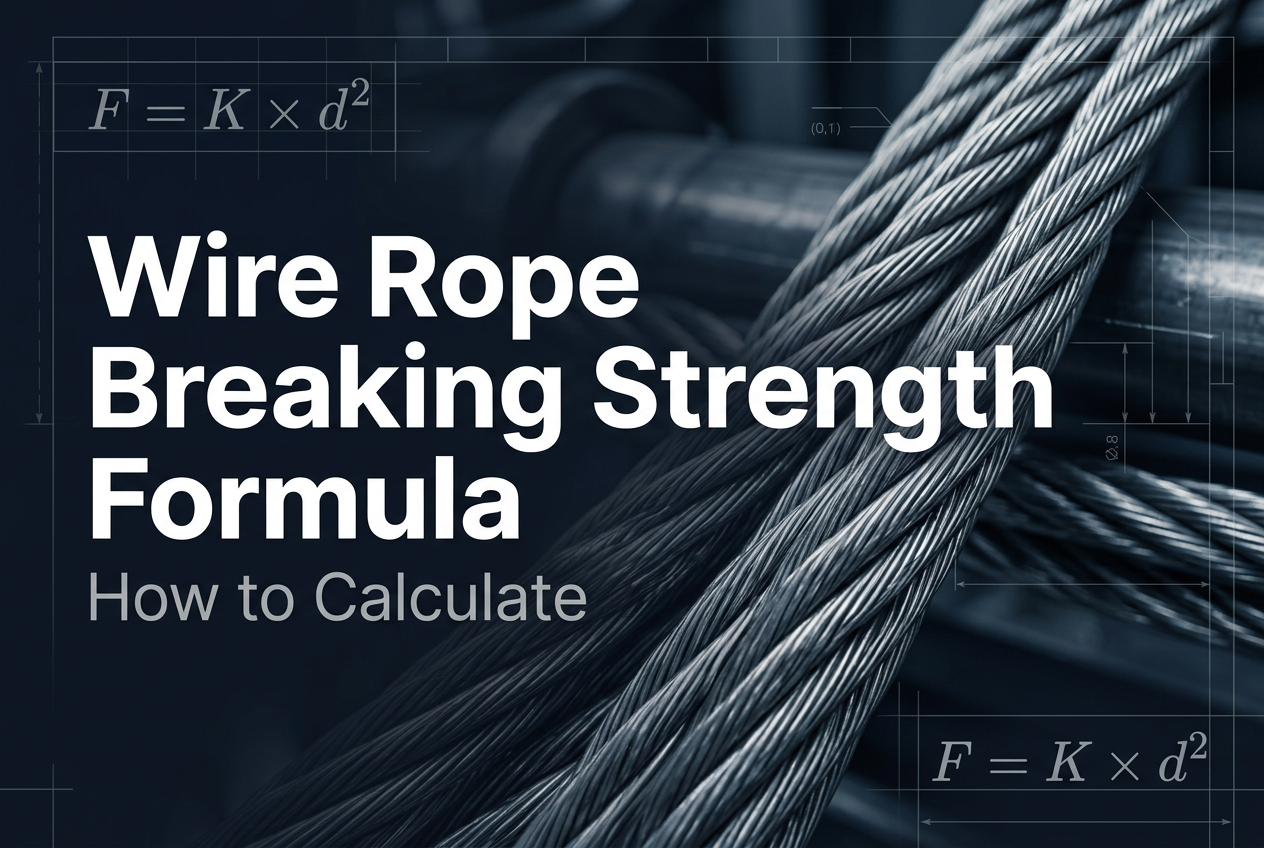
MBS (kN) = (d² × K × Rm) ÷ 1000
This is the form used by GB/T 9944, EN 12385, and ISO 2408 to tabulate minimum breaking force. Each term carries a distinct piece of physics:
- d² — nominal diameter squared (mm²). The force a rope can carry is proportional to the amount of steel in its cross-section, and cross-sectional area grows with the square of diameter. This is why doubling the diameter quadruples the strength: an 8mm rope is four times as strong as a 4mm rope of the same construction and grade, not twice. (Rope weight scales with d² for exactly the same reason — see our wire rope weight chart.) Note that d is the nominal diameter of the circumscribed circle around the strands, not a measured caliper reading.
- K — breaking force factor (dimensionless). A rope's cross-section is not solid steel: it is a bundle of round wires with air gaps between them, twisted along helical paths. K compresses all of that geometry into one number — how much of the nominal circle is actually steel, and how efficiently that steel converts to straight-line pull. Each construction has its own K, fixed by the governing standard; the full table is in the next section.
- Rm — tensile grade of the wire (MPa = N/mm²). The minimum tensile strength of the individual drawn wires before stranding. Stainless steel rope is supplied almost exclusively in 1570 or 1770 MPa; carbon steel rope also comes in 1960 MPa and above. A higher grade means stronger wire, and MBS scales linearly with it.
- ÷ 1000 — unit conversion. d² × K × Rm yields newtons (mm² × N/mm²); dividing by 1000 converts to kilonewtons. To express the result in pounds-force, multiply kN by 224.8; for kilograms-force, multiply by 102.
Breaking Force Factors (K) by Construction
K values are fixed by standard — GB/T 9944-2015 for stainless steel rope and the EN 12385 family for general steel rope publish consistent figures. The table below lists the factors for the constructions covered in this blog, together with a 6mm / 1770 MPa sample calculation so you can see the effect of construction alone:
| Construction | Core | K (breaking force factor) | 6mm @ 1770 MPa example |
|---|---|---|---|
| 1x7 (strand) | — | 0.59 | 37.6 kN (8,450 lbs) |
| 1x19 (strand) | — | 0.571 | 36.4 kN (8,173 lbs) |
| 7x7 | Steel (WSC) | 0.426 | 27.1 kN (6,103 lbs) |
| 7x19 | Steel (WSC) | 0.393 | 25.1 kN (5,633 lbs) |
| 6x19 | Fiber / IWRC | 0.330 / 0.356 | 21.0 / 22.7 kN |
| 6x37 | Fiber / IWRC | 0.330 / 0.356 | 21.0 / 22.7 kN |
Sources: 1x19, 7x7, and 7x19 factors are derived from the GB/T 9944-2015 minimum breaking force tables for stainless steel rope (and agree with EN 12385-10 / -4 practice); 6x19 and 6x37 factors are the EN 12385-4 values for round-strand ropes with fiber core (FC) and independent wire rope core (IWRC) respectively.
Two patterns are worth noting. First, the fewer and thicker the wires, the higher the K: solid-feeling strands (1x19) sit near 0.57 while flexible many-wire ropes (7x19) drop below 0.40 — the physics behind this is covered in the fill factor section further down. Second, 6x19 and 6x37 share the same K: within a class, subdividing strands into more, finer wires changes flexibility and wear behavior, not rated strength. That trade-off between strength and flexibility is exactly the choice explained in our 7x7 vs 7x19 construction comparison.
Tensile Grades: 1570 vs 1770 MPa
Rm enters the formula linearly, so the grade comparison is simple: 1770 MPa rope is about 13% stronger than 1570 MPa rope of the same diameter and construction (1770 ÷ 1570 = 1.127). A 6mm 7x7 rope breaks at a minimum of 27.15 kN in 1770 grade but only 24.08 kN in 1570 grade.
When to specify which:
- 1770 MPa is the default for stainless wire rope. Most catalog tables — including our breaking strength chart — are published at 1770 MPa, and it is the grade to assume when a datasheet doesn't say otherwise. Choose it whenever strength per millimeter matters: lifting, rigging, guy wires, and any case where a smaller diameter saves weight or cost.
- 1570 MPa trades strength for ductility. Lower-strength wire is drawn less severely, which leaves it slightly softer and more forgiving in repeated bending and hand-forming. It appears in some flexible cords, decorative cable, and applications where the rope is formed around tight radii rather than loaded near its limit.
- Don't mix grades in a calculation. If your supplier quotes 1570 MPa rope against a table computed at 1770 MPa, the real capacity is 11% lower than the table suggests. Always confirm Rm on the certificate before comparing numbers.
Worked Examples: Step by Step
Each example follows the same three steps: square the diameter in millimeters, multiply by K and Rm, divide by 1000. Results are cross-checked against the published GB/T 9944-2015 values.
Example 1 — 3mm 7x7 rope, 1770 MPa
- d² = 3.0² = 9.0 mm²
- K for 7x7 = 0.426; Rm = 1770 MPa
- MBS = 9.0 × 0.426 × 1770 ÷ 1000 = 6.79 kN
- Imperial: 6.79 × 224.8 ≈ 1,527 lbs (692 kgf)
The published table value for 3mm 7x7 is 6.79 kN / 1,527 lbs — the formula reproduces it exactly, because the table was generated from this formula in the first place.
Example 2 — 1/4" 7x19 rope, 1770 MPa (imperial workflow)
For imperial sizes, convert to millimeters first — the formula only works in metric units:
- d = 0.25 in × 25.4 = 6.35 mm, so d² = 40.32 mm²
- K for 7x19 = 0.393; Rm = 1770 MPa
- MBS = 40.32 × 0.393 × 1770 ÷ 1000 = 28.0 kN
- Imperial: 28.0 × 224.8 ≈ 6,306 lbs (2,860 kgf)
One trap to avoid: much "1/4 inch" rope sold internationally is actually metric 6.0mm stock, which computes to 36.0 × 0.393 × 1770 ÷ 1000 = 25.06 kN (5,633 lbs) — about 11% less than a true 6.35mm rope. Check whether your certificate states 6.0mm or 6.35mm before relying on either number.
Example 3 — 10mm 1x19 strand, 1770 MPa
- d² = 10.0² = 100 mm²
- K for 1x19 = 0.571; Rm = 1770 MPa
- MBS = 100 × 0.571 × 1770 ÷ 1000 ≈ 101.0 kN
- Imperial: 101.0 × 224.8 ≈ 22,700 lbs (10,300 kgf)
The published value is 100.98 kN / 22,698 lbs. If the same strand were ordered in 1570 MPa grade, the result would drop to 100 × 0.571 × 1570 ÷ 1000 ≈ 89.6 kN — the linear effect of Rm at work.
Metallic Cross-Section & Fill Factor
Why does K vary so much between constructions — 0.571 for a 1x19 strand but only 0.393 for 7x19? Unpack K and it turns out to be the product of three physical quantities:
K = (π ÷ 4) × f × ks
- π ÷ 4 ≈ 0.785 converts d² into the area of the nominal circumscribed circle — the largest cross-section the rope could theoretically occupy.
- f — the fill factor is the fraction of that circle actually occupied by steel. Round wires can never tile a circle completely: a 1x19 strand fills about 76% of its envelope, a 7x19 rope with its inter-strand valleys only about 55%, and a fiber-core 6x19 rope even less, since its center is rope fiber rather than steel.
- ks — the spinning factor accounts for the helical path of each wire. A wire twisted around the rope axis carries axial load at an angle, and lay angles cost a few percent per stranding operation: roughly 0.95–0.96 for a single-operation strand like 1x19, and around 0.90 for a double-stranded rope like 7x19, which is twisted once into strands and again into a rope.
Check the arithmetic for 1x19: 0.785 × 0.76 × 0.96 ≈ 0.573 — the standard's 0.571 almost exactly. For 7x19: 0.785 × 0.556 × 0.90 ≈ 0.393. So the K table is not arbitrary: every construction pays for its flexibility twice, first in steel displaced by gaps and cores, and again in lay-angle losses. This is the quantitative reason a flexible rope can never match a rigid strand of the same diameter for raw strength.
Formula vs Chart: When to Use Which
The formula and the published tables are two views of the same data, so use whichever is faster for the job:
- Use the chart for any standard size in 1x19, 7x7, or 7x19 — our wire rope breaking strength chart lists every catalog diameter from 0.5mm to 16mm in kN, kgf, and lbs, with no arithmetic and no rounding decisions on your side.
- Use the formula when the chart can't help: an in-between or oversized diameter, a construction the table doesn't cover, a 1570 MPa quote you need to compare against 1770 values, or a sanity check on a supplier's datasheet that looks optimistic.
For specification work, do both: calculate first, then confirm the final selection against the standard's table and the manufacturer's certificate, since the certificate is the number that governs.
Why Calculated Values Differ from Test Results
Pull a real rope to destruction and it will almost always break above the calculated figure — typically by 5–10%. This is by design, not error. The formula yields the minimum breaking strength: the floor value the manufacturer guarantees, set so that essentially every production sample passes. Actual results run higher because wire is drawn to tensile strengths comfortably above the nominal grade (1770 MPa wire often tests at 1800–1900 MPa), and stranding losses in a well-made rope are smaller than the standard's conservative allowance.
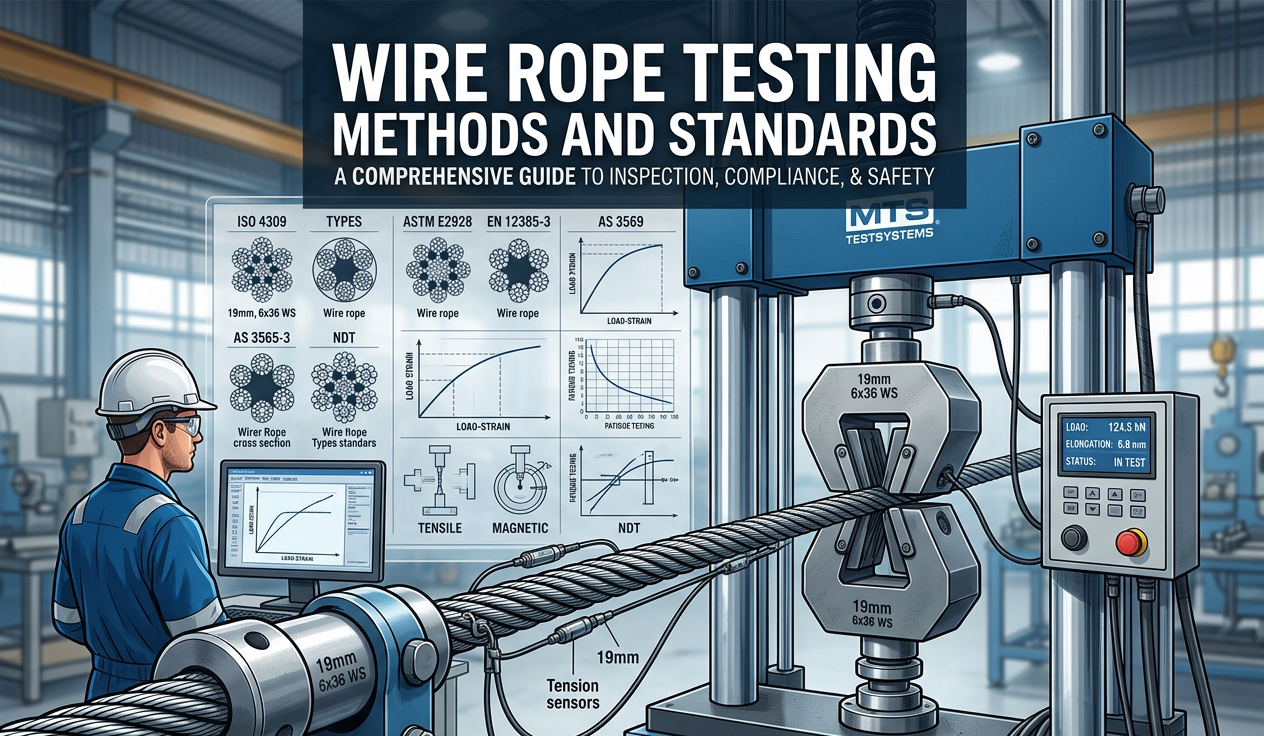
Manufacturers verify this on every production lot with destructive tensile tests — a sample is pulled to failure on a calibrated test bed and the result recorded on the mill certificate. Our guide to wire rope testing methods and standards walks through the full procedure, from sample preparation to what a valid break looks like. For design purposes, always use the minimum (calculated or certified) value, never a measured break result: the next rope off the same machine is only guaranteed to meet the minimum.
From Breaking Strength to Working Load
A calculated MBS is a failure value — no rope should ever see it in service. The number you design to is the Working Load Limit: WLL = MBS ÷ Safety Factor, with 5:1 for general lifting and 10:1 whenever the rope carries people. Continuing the Quick Answer example, a 6mm 7x7 rope at 27.1 kN MBS has a WLL of 5.4 kN (about 553 kgf / 1,220 lbs) at 5:1. Safety factor tables by application, sling angle effects, and an interactive calculator are all in our working load limit (WLL) guide.
Frequently Asked Questions
What is the formula for wire rope breaking strength?
MBS (kN) = (d² × K × Rm) ÷ 1000, where d is the nominal diameter in mm, K is the breaking force factor of the construction (0.426 for 7x7, 0.393 for 7x19, 0.571 for 1x19 per GB/T 9944-2015), and Rm is the wire tensile grade in MPa (typically 1570 or 1770). Multiply the result by 224.8 to convert to pounds-force.
What is the breaking strength of 6mm wire rope?
At the 1770 MPa grade, 6mm stainless steel wire rope has a minimum breaking strength of 27.15 kN (6,103 lbs) in 7x7 construction, 25.06 kN (5,633 lbs) in 7x19, and 36.36 kN (8,173 lbs) in 1x19. Divide by your application's safety factor to get the working load limit.
What does 1770 MPa mean?
1770 MPa is the tensile grade — the minimum tensile strength of the individual drawn wires that make up the rope, in megapascals (N/mm²). It describes the wire material, not the whole rope: rope strength also depends on diameter and construction via the formula. 1770 MPa is the standard grade for stainless wire rope; 1570 MPa rope of the same size is about 11% weaker.
Why is my rope's actual breaking strength higher than the calculated value?
Because the formula gives the minimum guaranteed value, not the expected one. Real wire is drawn above its nominal grade and well-made rope loses less strength in stranding than the standard assumes, so destructive tests typically come in 5–10% above the calculated MBS. Always design to the minimum value — the surplus is the manufacturer's margin, not yours.
How do I calculate breaking strength in pounds?
Work the formula in metric, then convert: multiply kN by 224.8 to get pounds-force. For an imperial diameter, convert to millimeters first (inches × 25.4). Example: 1/4" 7x19 → d = 6.35mm → MBS = 6.35² × 0.393 × 1770 ÷ 1000 = 28.0 kN → 28.0 × 224.8 ≈ 6,306 lbs.
Calculate It — Then Certify It
The formula tells you what a rope should do; a mill certificate proves what your rope actually does. If you're specifying wire rope for a real project, start with our guide on how to choose the right stainless steel wire rope, then request rope with a break-test certificate for every production lot. Our engineering team can confirm construction, grade, and diameter against your required breaking strength and typically responds within 2 hours during business hours.